Hall of Mirrors at Versailles: History, Highlights & Visitor Guide
The Hall of Mirrors at Versailles: 357 mirrors, Le Brun's ceiling, the Treaty of Versailles, what to look for inside, and how to see it without rushing.
The Hall of Mirrors at Versailles is the room most people picture when they imagine the Palace of Versailles.
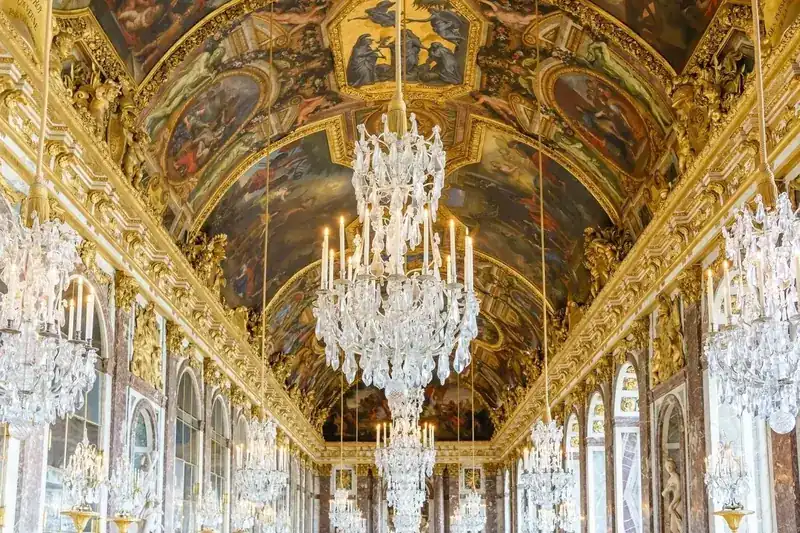
Stretching 73 metres along the garden side of the château, the gallery sets 17 windows opposite 17 mirrored arches containing 357 mirrors. Above them, Charles Le Brun’s painted ceiling turns the reign of Louis XIV into an elaborate visual celebration of royal power.
But the Hall of Mirrors is much more than a beautiful room.
It was built as a political statement. It became a stage for royal ceremony and diplomatic reception. In 1871, the German Empire was proclaimed here. In 1919, the Treaty of Versailles was signed in the same gallery after the First World War.
Today it is the most famous interior at Versailles and one of the highlights of almost every first visit.
This guide covers what the Hall of Mirrors is, why it was built, what to look for inside, the history behind its mirrors and ceiling, and how to plan your visit without rushing through it.
The Hall is not sold separately, and it can be very crowded in the middle of the day — which is the case for entering with a timed slot and someone to tell you what you’re looking at. The skip-the-line guided tour featured on this site walks the State Apartments, the King’s Bedroom and the Hall of Mirrors in 90 minutes, from $79, and guests rate it 4.7/5 across 11,869 reviews. Prices and opening arrangements change, so confirm the current details for your date.
What is the Hall of Mirrors?
The Hall of Mirrors, or Galerie des Glaces, is the grand central gallery connecting the War Room and the Peace Room in the Palace of Versailles.
It lies between the King’s and Queen’s State Apartments and overlooks the formal gardens.
The gallery was designed by the architect Jules Hardouin-Mansart; the ceiling decoration was created by Charles Le Brun, Louis XIV’s First Painter.
Work began in 1678 and was completed in the 1680s.
Its dimensions and decoration were calculated to impress visiting courtiers, ambassadors and foreign rulers while glorifying the political, military, economic and artistic achievements of Louis XIV.
Hall of Mirrors at a glance
| Feature | Detail |
|---|---|
| French name | Galerie des Glaces |
| Length | 73 metres |
| Architect | Jules Hardouin-Mansart |
| Ceiling decoration | Charles Le Brun |
| Construction | Began in 1678 |
| Windows | 17 |
| Mirrored arches | 17 |
| Mirrors | 357 |
| Adjacent rooms | War Room and Peace Room |
| Famous historical event | Treaty of Versailles signed here on 28 June 1919 |
Why was the Hall of Mirrors built?
Before the Hall of Mirrors existed, the space between the King’s and Queen’s apartments was an open terrace designed by Louis Le Vau.
The terrace gave a magnificent view across the gardens, but it was exposed to the weather and not especially practical in the French climate.
Jules Hardouin-Mansart replaced it with an enclosed gallery.
The new design solved the practical problem and created something far more ambitious: a ceremonial space that folded architecture, mirrors, gardens, sculpture and ceiling painting into a single statement about Louis XIV’s monarchy.
It also created a grand connection between the two sides of the royal apartments.
Why are there so many mirrors?
Mirrors were extraordinarily expensive luxury objects in the 17th century.
Venice had long dominated high-quality mirror production, especially through the glassmakers of Murano.
By decorating Versailles with hundreds of mirrors, France was not simply displaying wealth. It was demonstrating that French manufacturing could compete with an industry Venice was famous for.
The gallery holds 357 mirrors arranged across 17 arches, each arch corresponding to one of the 17 windows opposite it.
During daylight, the mirrors reflect natural light and the gardens back into the room. In the evening, candlelight could multiply across the mirrored surfaces during special celebrations.
The effect made the room appear brighter, larger and even more luxurious.
What makes the Hall of Mirrors so famous?
Several things come together here.
The scale
At 73 metres long, the Hall is not a decorative corridor. It is a monumental architectural space.
The mirrors
Hundreds of mirrors were an extraordinary luxury in the 17th century.
The garden views
The windows overlook André Le Nôtre’s formal gardens and the Grande Perspective running toward the Grand Canal.
The ceiling
Charles Le Brun’s paintings celebrate the achievements of Louis XIV through allegory, classical symbolism and scenes tied to major events of his reign.
The history
The room later became the setting for events that reached far beyond the French monarchy, including the proclamation of the German Empire in 1871 and the signing of the Treaty of Versailles in 1919.
Few rooms in Europe combine architecture, art and political history on this scale.
Other experiences you might enjoy
The Hall of Mirrors is one room on a much longer route. Most visitors pair it with the State Apartments, the King’s Bedroom and the War and Peace Rooms, then spend the afternoon in the Gardens of Versailles among Latona’s and Apollo’s fountains, or walk out to the Grand Trianon, the Petit Trianon and Marie Antoinette’s Queen’s Hamlet. Day trips from Paris bundle the journey with a guide, and some pair Versailles with Giverny and Monet’s garden. Here’s what’s bookable right now:
What to look for inside the Hall of Mirrors
The Hall can be crowded, and many visitors instinctively walk in, take a few photographs and continue. That is how the details get missed.
Here are the main things worth looking at.
1. The 17 mirrored arches
Start with the feature that gave the gallery its name.
There are 17 large arches filled with mirrors, positioned directly opposite 17 tall windows.
The symmetry matters. The mirrors do not work as separate decorative panels — they visually answer the windows, reflecting both daylight and the gardens beyond.
Stand roughly in the centre of the gallery and look alternately toward the windows and the mirrors. The relationship between interior and landscape becomes much clearer.
2. The 357 mirrors
The Hall contains 357 individual mirror panels.
Modern visitors are used to enormous sheets of glass, so the use of multiple smaller panels can look odd. In the 17th century, producing large flawless mirrors was technically difficult and extremely expensive.
Their number was part of the message: France had both the resources and the manufacturing capability to fill a royal gallery with one of Europe’s most luxurious materials.
3. Charles Le Brun’s ceiling
Don’t spend the whole visit looking at eye level. The vaulted ceiling is one of the most important parts of the room.
Charles Le Brun created 30 painted compositions celebrating major events from the first decades of Louis XIV’s personal rule.
They are not documentary history. They use:
- gods and figures from classical mythology
- allegorical figures
- symbols of nations and political ideas
- military imagery
- personifications of virtues and victories
The result is political storytelling in paint. Louis XIV’s victories, reforms and government are elevated into a heroic visual narrative.
4. The view of the gardens
Turn away from the mirrors and look through the windows.
The central windows give one of the best elevated views of the Versailles Gardens. From here you can see the great east–west perspective developed by André Le Nôtre, linking:
- the Palace
- Water Parterre
- Royal Way
- Apollo’s Fountain
- Grand Canal
- distant horizon
The connection is intentional. The Hall of Mirrors presents royal power inside the Palace; the Gardens continue the same visual language outside. Our Versailles gardens guide follows that axis on foot.
5. The marble pilasters
Between the mirrors are richly coloured marble pilasters.
Their gilded bronze capitals were designed in a specifically French style and carry royal and national symbols. Look for:
- the fleur-de-lis
- the royal sun
- Gallic roosters
These details reinforce the political character of the gallery.
6. The War Room
At one end of the Hall is the War Room, or Salon de la Guerre.
Its decoration celebrates French military victory. Its most striking feature is the large relief of Louis XIV on horseback, shown defeating his enemies.
The room prepares you for the themes of victory and royal glory that continue across the Hall of Mirrors ceiling.
7. The Peace Room
At the opposite end is the Peace Room, or Salon de la Paix.
Architecturally it mirrors the War Room, but its decoration focuses on the benefits of peace.
The two spaces create a deliberate sequence:
War → royal achievements in the Hall of Mirrors → Peace
Look into both rather than treating the Hall as an isolated attraction.
How was the Hall of Mirrors used under Louis XIV?
Despite the decoration, the Hall of Mirrors was not simply a ballroom.
On ordinary days, courtiers and visitors crossed it while moving through the Palace. It functioned as:
- a passage
- a meeting place
- a waiting area
- a setting for court life
Its grandest ceremonial use was reserved for special occasions:
- diplomatic receptions
- royal weddings
- balls
- games
- major court celebrations
For important diplomatic audiences, the royal throne could be placed near the Peace Room end of the gallery. Foreign ambassadors then had to cross the entire length of the Hall before reaching the king.
Picture the effect: mirrored walls, painted ceiling, marble, gilding, rows of courtiers, and a long approach toward Louis XIV. The room itself was part of the diplomatic performance.
Famous ambassadors in the Hall of Mirrors
The Hall was used to receive several major foreign embassies. Among the most famous:
- the Doge of Genoa in 1685
- ambassadors from Siam in 1686
- the Persian embassy in 1715
- ambassadors of the Ottoman Empire in 1742
These receptions were carefully choreographed. Foreign representatives were not simply meeting the French king; they were being shown a physical representation of French royal power.
Was the Hall of Mirrors a ballroom?
Sometimes, but not routinely.
The gallery is often imagined permanently filled with chandeliers, music and dancing. In reality, grand balls were exceptional events rather than the Hall’s everyday purpose.
Temporary lighting and decoration could transform the gallery for major celebrations, particularly royal weddings. Most of the time, the Hall had a more formal and ceremonial appearance.
That distinction explains why the room’s design is relatively open: its proportions, ceiling and mirrored walls were meant to dominate the space even without elaborate temporary decoration.
The German Empire was proclaimed here in 1871
One of the great historical ironies of the Hall of Mirrors happened during the Franco-Prussian War.
Prussian and allied German forces defeated France and occupied Versailles.
On 18 January 1871, King Wilhelm I of Prussia was proclaimed German Emperor in the Hall of Mirrors.
The location was deeply symbolic. A space created to celebrate French royal power became the setting for the declaration of a newly unified German Empire after France’s defeat.
That event gave the Hall a major place in German as well as French history.
The Treaty of Versailles and the Hall of Mirrors
Almost half a century later, the symbolism was reversed.
After Germany’s defeat in the First World War, representatives of the Allied powers and Germany gathered in the Hall of Mirrors.
On 28 June 1919, the Treaty of Versailles was signed here.
The date itself mattered: exactly five years after the assassination of Archduke Franz Ferdinand in Sarajevo on 28 June 1914.
The treaty imposed a post-war settlement between Germany and the Allied powers and became one of the defining political documents of the 20th century.
The choice of room carried its own weight, because it was the same gallery where the German Empire had been proclaimed in 1871.
Where was the Treaty of Versailles signed?
The treaty was signed in the Hall of Mirrors at the Palace of Versailles, near Paris.
This causes confusion, because visitors sometimes assume there is a separate “Treaty of Versailles room”.
There is not. The famous mirrored gallery itself was the setting. When you visit today, you are standing in the same long space where the representatives gathered in 1919.
What happened to the Hall during the French Revolution?
The French royal family left Versailles in October 1789, during the French Revolution.
The Palace then faced an uncertain future. Much of the royal furniture was dispersed, but the building itself survived.
The Hall of Mirrors remained part of the Palace and underwent restoration and conservation work over the following centuries.
In the 19th century, Versailles was transformed into a museum dedicated to French history under King Louis-Philippe.
The Hall therefore outlived the monarchy that created it, and gradually became a national historical monument rather than simply a royal ceremonial room.
Restoration of the Hall of Mirrors
A historic interior visited by millions of people needs constant conservation.
The Hall has undergone several restorations, including a major programme in the early 21st century. Conservation work has addressed:
- mirrors
- paintings
- marble
- gilding
- decorative sculpture
- lighting
- architectural surfaces
More recent work has reconsidered how the gallery should be lit, so that visitors can better appreciate the architecture and Le Brun’s ceiling while reflecting its historical character more accurately.
The Hall you see today is not frozen in time. Keeping it looking this way takes continuous research and conservation.
Are the mirrors original?
A significant proportion of the historic mirror material has survived, although the gallery has been repaired and restored over the centuries.
It would be misleading to imagine that every pane has remained untouched since the reign of Louis XIV. Historic interiors of this age inevitably contain a mixture of original material, later replacements and restored components.
What matters is that the overall arrangement — the 17 mirrored arches facing the 17 windows — preserves the design that made the gallery revolutionary.
How long does it take to visit the Hall of Mirrors?
The Hall itself doesn’t need a long dedicated visit. Most people spend around 10 to 20 minutes inside, depending on crowds and how closely they want to examine the decoration.
But the Hall is part of a larger Palace route. For the main Palace interiors, plan roughly 1.5 hours or more. If you enjoy art, architecture or history, allow longer.
The challenge isn’t the physical size of the Hall. It’s getting enough space and time to look properly when the gallery is busy — which is what our guide to what to expect on a palace tour is really about.
Do you need separate Hall of Mirrors tickets?
No separate ticket is normally required just for the Hall of Mirrors.
The Hall is part of the main Palace visit and is included with any admission covering the Palace. So choose your Versailles ticket based on what else you want to see.
Palace ticket
Best if your priority is:
- State Apartments
- Hall of Mirrors
- main Palace interiors
One thing worth knowing before you go looking for one: a strictly palace-only ticket is a château box-office product. The self-guided tickets resold online — including the one on this site — bundle the gardens and the Trianon estate as well, so if the Hall of Mirrors is genuinely all you want, buying direct is the cleaner route.
Passport
Better if you also want:
- Gardens on paid-event days
- Grand Trianon
- Petit Trianon
- Queen’s Hamlet
- the wider Versailles estate
The full-access Passport ticket sold here covers the whole domain from $29 and is rated 4.6/5 across 47,078 reviews; our Passport vs Palace ticket comparison sets out exactly where the line falls, and the Trianon Estate guide covers what the Passport unlocks at the far end of the park.
There is generally no need to hunt for a special “Hall of Mirrors ticket”.
Can you visit only the Hall of Mirrors?
For ordinary independent admission, the Hall forms part of the route through the Palace rather than a standalone attraction.
Plan to enter the Palace and follow the visitor route through the State Apartments. The Hall of Mirrors is one of the main highlights along it.
Where is the Hall of Mirrors inside Versailles?
The Hall is on the first floor of the central Palace, along the western façade overlooking the Gardens.
On the standard route through the State Apartments, you approach it from the War Room. At the opposite end lies the Peace Room.
You don’t need to navigate the château independently to find it — the main visitor circuit leads you there.
What is the best time to see the Hall of Mirrors?
Crowding is the main factor. Because nearly every Palace visitor wants to see the Hall, it gets extremely busy in the middle of the day.
For a more comfortable experience, visit the Palace:
- close to opening time
- later in the afternoon, when conditions permit
The Palace itself recommends early morning or later afternoon for avoiding the heaviest crowds. No time guarantees an empty Hall, particularly in peak season. Our crowd-avoidance guide has the month-by-month and day-of-week detail.
If photography matters to you, patience is usually more useful than hunting for a crowd-free slot.
Can you take photos in the Hall of Mirrors?
Personal photography is generally permitted in the Palace under normal visitor rules, but restrictions can apply to equipment and professional use.
For ordinary visitors:
- avoid blocking the route
- don’t use equipment that interferes with other visitors
- follow staff instructions
- check current photography rules if you intend commercial or professional shooting
The Hall is genuinely difficult to photograph, because of reflections, strong window light and crowds.
Best places to take photos
From one end of the gallery
This emphasises the full 73-metre perspective.
Near the centre
This gives the classic composition of windows facing mirrored arches.
Facing the gardens
This shows how the Hall connects visually with the landscape.
Looking up
The ceiling is often left out of photographs but is one of the room’s most important features.
Through a mirrored reflection
Using the mirrors to frame the windows and other visitors usually produces a more interesting image than shooting the room straight on.
Why does the Hall of Mirrors face the gardens?
The location is fundamental to the design.
The Hall replaced an open terrace that already occupied the garden side of the Palace. By setting 17 windows opposite 17 mirrored arches, Hardouin-Mansart kept the strong relationship with the landscape while creating an enclosed ceremonial gallery.
The mirrors effectively bring the garden light and views back into the room. From the central windows, the monumental garden perspective appears to continue directly out of the architecture of the Palace.
It is one of the clearest examples of Versailles being designed as a single composition rather than a building with a separate garden behind it.
Why is the ceiling important?
The mirrors get most of the attention today, but politically the ceiling may matter more.
Le Brun’s decoration celebrates the first 18 years of Louis XIV’s personal rule, beginning in 1661.
Rather than relying entirely on ancient mythology to represent the king, the ceiling refers to events associated with Louis XIV himself:
- military victories
- diplomatic successes
- political authority
- reforms of government
- economic achievements
Ancient gods and allegorical figures still appear, but they support a narrative built around the living French monarch.
A 17th-century visitor was therefore surrounded by a carefully designed message: France was prosperous, victorious, artistically dominant and ruled by a powerful king.
What does the sun symbol mean?
Louis XIV is famously associated with the sun, and is often called the Sun King.
At Versailles, solar imagery appears repeatedly in architecture, decoration and garden mythology. The sun stood for qualities that suited his image of monarchy:
- centrality
- order
- brilliance
- life-giving power
- authority
Apollo, the classical sun god, became particularly important in the iconography of Versailles. The symbolism runs well beyond the Hall of Mirrors and out into the gardens, including the famous Apollo’s Fountain.
Hall of Mirrors vs State Apartments
The Hall of Mirrors is part of the larger ceremonial sequence of the Palace.
The State Apartments are a series of richly decorated rooms given over largely to classical gods and royal functions.
The Hall is different because of its scale and architectural simplicity. Instead of moving through a succession of separate rooms, you suddenly enter one enormous gallery. That change in scale is a large part of why the Hall feels so dramatic.
Don’t rush the State Apartments just to reach it, though. The rooms leading to the Hall supply the context that makes it work.
Hall of Mirrors vs Royal Opera
Both are spectacular ceremonial interiors, but they served very different purposes.
The Hall of Mirrors was:
- a passage and gathering place
- a diplomatic setting
- occasionally used for balls and celebrations
- part of the State Apartment sequence
The Royal Opera was:
- a purpose-built performance space
- designed for theatre, opera and major festivities
- completed much later, in the reign of Louis XV
If you’re interested in the grand ceremonial spaces of Versailles, both are worth seeing — though access to the Opera can depend on the visit or guided-tour programme.
Is the Hall of Mirrors worth the hype?
Yes — but it helps to know what you’re looking at.
If you walk in expecting “a room with lots of mirrors”, the crowds make the experience feel rushed.
If you understand that the room combines:
- French manufacturing ambition
- royal propaganda
- architecture
- garden design
- diplomatic theatre
- German unification history
- the post-First World War settlement
the experience becomes much richer.
Few places let you stand in a single room tied so strongly to both 17th-century monarchy and 20th-century international politics.
Suggested 15-minute Hall of Mirrors visit
If the gallery is crowded, use a simple plan.
Minutes 1–3: stop at the entrance
Look down the full length of the Hall before joining the flow of visitors.
Minutes 3–6: study the mirrors and windows
Notice how each mirrored arch corresponds to a window.
Minutes 6–9: look up
Spend several minutes on Le Brun’s ceiling rather than only the mirrors.
Minutes 9–12: look toward the gardens
Find the central perspective running toward the Grand Canal.
Minutes 12–15: look back at the whole space
Before you leave, turn around and see the gallery from the opposite direction.
It takes very little extra time and gives you a far better understanding of the room.
Common mistakes when visiting the Hall of Mirrors
Only looking at the mirrors
The ceiling, marble and garden views matter just as much.
Rushing through for a photo
This is one of the most historically significant rooms in the Palace. Give it a few minutes beyond photography.
Expecting it to be empty
It is the most famous room at Versailles. Crowds are normal.
Looking for a separate Hall of Mirrors ticket
The gallery is part of the Palace visit.
Ignoring the War and Peace Rooms
They frame the Hall and complete its political and artistic programme.
Confusing the Treaty of Versailles with the creation of the Hall
The gallery was created in the reign of Louis XIV, more than two centuries before the 1919 treaty.
Frequently asked questions
Where is the Hall of Mirrors?
The Hall of Mirrors is inside the Palace of Versailles, west of Paris, overlooking the formal Gardens.
How many mirrors are in the Hall of Mirrors?
There are 357 mirrors arranged across 17 mirrored arches.
How long is the Hall of Mirrors?
The gallery is approximately 73 metres long.
Who designed the Hall of Mirrors?
The architecture was designed by Jules Hardouin-Mansart, while Charles Le Brun created the famous ceiling decoration.
When was the Hall of Mirrors built?
Construction began in 1678, replacing an earlier terrace between the King’s and Queen’s apartments.
Why did Louis XIV build the Hall of Mirrors?
It gave a practical enclosed link between the royal apartments while also serving as an extraordinary display of French political, artistic and economic power.
What happened in the Hall of Mirrors in 1871?
The German Empire was proclaimed there on 18 January 1871, following France’s defeat in the Franco-Prussian War.
Was the Treaty of Versailles signed in the Hall of Mirrors?
Yes. The Treaty of Versailles was signed in the Hall of Mirrors on 28 June 1919.
Do I need a separate ticket for the Hall of Mirrors?
No. The Hall is included as part of the main Palace visit with an appropriate Palace admission ticket.
Can you visit the Hall of Mirrors without touring Versailles Palace?
Normally, no. It forms part of the Palace visitor route rather than a separate attraction.
How much time should I spend in the Hall of Mirrors?
Around 10 to 20 minutes is enough for the main features, though crowd levels affect the pace.
What rooms are next to the Hall of Mirrors?
The War Room is at one end and the Peace Room at the other.
What can you see from the Hall of Mirrors windows?
The windows overlook the Versailles Gardens and the great central perspective running toward the Grand Canal.
Is the Hall of Mirrors original?
The architectural arrangement and significant historic material survive, but like any 17th-century interior the gallery has undergone restoration, conservation and replacement of some components over time.
Final thoughts
The Hall of Mirrors at Versailles became famous because Louis XIV intended it to be unforgettable.
Its 17 windows and 17 mirrored arches turn light and garden views into part of the architecture. Its 357 mirrors once advertised France’s ability to rival Venetian luxury manufacturing. Above them, Charles Le Brun’s ceiling presents Louis XIV’s reign as a sequence of victories and achievements.
Then history gave the room entirely new meanings.
The German Empire was proclaimed here in 1871. The Treaty of Versailles was signed here in 1919. A gallery built to glorify a 17th-century French king became the stage for some of the most consequential political events in modern European history.
When you visit, take the photograph — but don’t stop there.
Look up at the ceiling, turn toward the gardens, look into the War and Peace Rooms, and remember that this was never simply a decorative gallery.
It was architecture designed as power.
Walk the Hall of Mirrors — Without the Line
Join 11,869+ guests who rated this Versailles palace tour 4.7/5. Skip-the-line entry, a 90-minute licensed guide, and full gardens access — with free cancellation.
Check Availability & Book