History of the Palace of Versailles: From Louis XIII's Hunting Lodge to the French Revolution
The history of the Palace of Versailles, from Louis XIII's hunting lodge and Louis XIV's court to Marie Antoinette, the Revolution and the museum you visit today.
The Palace of Versailles began as a modest hunting lodge. Over the 17th century, that lodge became one of the most famous royal residences in the world and the political center of the French monarchy. Under Louis XIV, Versailles was more than a home: it was a system of government, a stage for court life and a carefully built symbol of royal authority. Under Louis XV and Louis XVI the estate kept changing, while the monarchy faced growing political and financial pressure.
By 1789, Versailles had become inseparable from the crisis of the French monarchy. The royal family left the Palace during the French Revolution, ending more than a century of court life. Yet Versailles survived, and it later became a museum, a national monument, a diplomatic setting and one of France’s most visited historic sites. This guide follows that story from Louis XIII’s first hunting lodge through Louis XIV’s transformation of the estate, the reigns of Louis XV and Louis XVI, Marie Antoinette’s private world, the Revolution and the Palace’s later life, so you know which layer of history you are standing in on your visit.
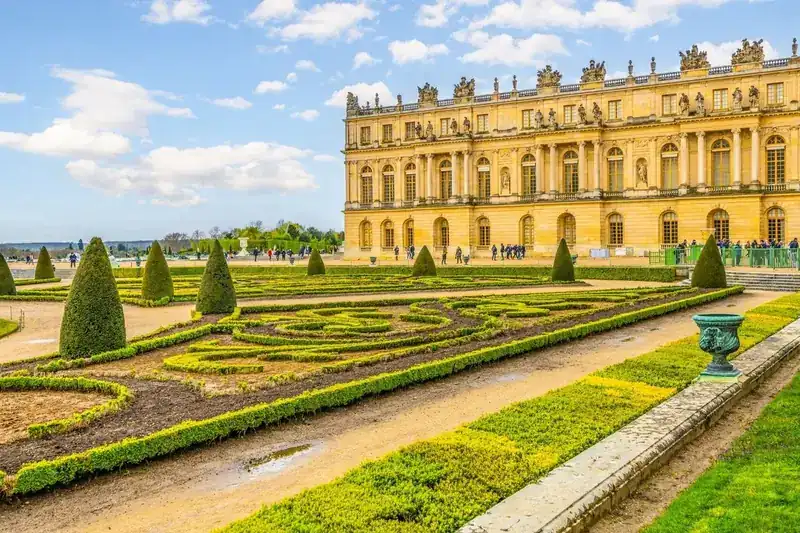
Most of this history is invisible on a self-guided walk: the rooms carry few labels about who was allowed where, or why. A guide fills that gap. The Versailles: Skip-the-Line Tour of Palace and Gardens Access takes you through the State Apartments, the King’s Bedchamber and the Hall of Mirrors with a licensed guide for 90 minutes, then leaves you the Gardens, from $80 and rated 4.7/5 from more than 12,000 reviews. Check dates for your trip here.
Versailles Before the Palace
Before Versailles became a byword for monarchy, it was a small settlement surrounded by forest and hunting land. The French royal family liked the area because it lay within easy reach of Paris and offered good hunting. The first major royal connection came through Louis XIII.
Louis XIII and the First Hunting Lodge
In 1623, Louis XIII built a small hunting lodge at Versailles. It was never meant to rival the major royal residences; it was a practical retreat where the king could stay while hunting.
A few years later, Louis XIII replaced the original lodge with a more substantial brick-and-stone château. That second building formed the core around which the later Palace of Versailles grew, and parts of it were kept when Louis XIV expanded the estate.
That is why Versailles was not put up all at once; it grew by repeated expansion around an older core.
Other experiences you might enjoy
You can cycle to the Grand Canal, where Louis XIV held boating parties, tour Marie Antoinette’s estate by golf cart, or add Monet’s Giverny to a day trip from Paris.
Why Did Louis XIV Choose Versailles?
Louis XIV inherited a monarchy that already moved between several royal residences. He did not make Versailles the seat of government straight away, but he grew more and more attached to the site. Several factors made it attractive.
Distance From Paris
Versailles was close enough to Paris to stay connected with the capital but far enough away to create a controlled royal environment.
Space
The estate offered enormous room for expansion. Louis XIV could build:
- new wings
- gardens
- ceremonial spaces
- residences
- service buildings
- stables
- a whole court infrastructure
Personal Attachment
Louis XIV enjoyed hunting and the surrounding landscape.
Political Opportunity
Versailles let the king reshape court life around himself, and that became one of the most important parts of its development.
Louis XIV and the Transformation of Versailles
Louis XIV became king in 1643, while still a child. His early reign was shaken by political instability, especially the civil conflicts known as the Fronde, and those years shaped his understanding of power and the dangers of noble opposition.
As an adult, Louis XIV steadily centralized authority around the monarchy, and Versailles became part of that strategy. Beginning in the 1660s, he launched major building campaigns that turned his father’s château into an enormous royal complex.
Who Built Versailles?
No single architect built the Palace. Several major figures shaped it.
Louis Le Vau
Le Vau led the major early expansions under Louis XIV. He created the famous envelope around Louis XIII’s earlier château.
Jules Hardouin-Mansart
Hardouin-Mansart later expanded Versailles further and designed some of its most famous features, including:
- Hall of Mirrors
- Grand Trianon
- major wings
- architectural elements around the Gardens
Charles Le Brun
Le Brun was Louis XIV’s principal decorator and artistic director. He created much of the symbolic decoration of the Palace, especially the ceiling of the Hall of Mirrors.
André Le Nôtre
Le Nôtre designed the formal Gardens, carrying the political message of the Palace out into the landscape.
Together, these architects, artists and designers created the Versailles associated with Louis XIV.
Why Was Versailles Built?
Versailles served several purposes at once. It was:
- a royal residence
- seat of government
- court
- diplomatic stage
- symbol of monarchy
- cultural center
- political instrument
Louis XIV used architecture and ceremony to organize aristocratic life around the king. At Versailles, access to the monarch became one of the most valuable forms of political currency.
Versailles and the Control of the Nobility
A common explanation for Versailles is that Louis XIV built it to “keep the nobles under control”. That is broadly true but easy to oversimplify. Louis XIV did not imprison the French aristocracy at Versailles. Court life instead gave powerful nobles strong reasons to spend time near the king, because access mattered.
A noble’s prestige could depend on:
- attending royal ceremonies
- securing appointments
- receiving court privileges
- gaining invitations
- being seen by the monarch
- taking part in daily rituals
Ambitious nobles competed for royal attention, and by organizing court life around himself, Louis XIV strengthened the monarchy’s social and political dominance.
The Court Moves to Versailles
In 1682, Louis XIV formally moved the royal court and central government to Versailles. It was one of the defining moments in the Palace’s history: from then on, Versailles was the main stage of the French monarchy.
Thousands of people lived or worked in and around the estate, including:
- royal family
- princes
- aristocrats
- ministers
- military officers
- servants
- artists
- guards
- clergy
- officials
Versailles was not simply a private residence. It worked like a political city organized around the person of the king.
What Was Daily Life Like at Versailles?
Etiquette governed life at Versailles, and the king’s daily routine became a public ritual. The most famous example was the lever, the ceremony of the king getting up and dressing. Who could attend each stage depended on rank and privilege.
The same principle applied to:
- meals
- chapel attendance
- receptions
- evening routines
- royal audiences
Even ordinary actions could carry political meaning. Court etiquette turned physical closeness to the king into status.
Louis XIV’s Bedroom
The King’s Bedchamber held an important ceremonial position within the Palace. Under Louis XIV, the bedroom was part of the ceremonial life of the court, not simply a private sleeping space. Courtiers gathered there for the rituals of:
- rising
- dressing
- receiving privileged courtiers
- retiring at night
It shows an important feature of Versailles: the line between public and private royal life was often very thin.
The Hall of Mirrors
One of Louis XIV’s most famous additions was the Hall of Mirrors. Construction began in 1678 under Jules Hardouin-Mansart, and the gallery replaced an earlier open terrace between the King’s and Queen’s apartments. The finished Hall stretches for 73 meters.
It contains:
- 17 windows
- 17 mirrored arches
- 357 mirrors
- marble decoration
- ceiling paintings by Charles Le Brun
The room stood for:
- royal power
- French manufacturing
- military success
- political ambition
- cultural prestige
It also became one of the main ceremonial spaces of the Palace. Our Hall of Mirrors guide covers what to look for when you walk through it.
Why Were Mirrors So Important?
Mirrors were expensive luxury goods in the 17th century, and Venice had long dominated high-quality mirror production. By filling a royal gallery with French-made mirrors, France showed off both its wealth and its industrial ambition.
The mirrors also reflected:
- candlelight
- garden views
- movement
- architectural space
They turned the gallery into a theatrical setting.
The Gardens of Versailles
The Gardens mattered as much as the Palace. André Le Nôtre reshaped the landscape into a vast geometric composition.
The design used:
- long axes
- fountains
- canals
- groves
- parterres
- sculpture
- carefully controlled views
The Gardens carried the same message as the Palace: order, control and royal authority. Nature itself appeared organized around the monarchy. Our Versailles gardens guide has a route through them.
Apollo and the Sun King
Louis XIV is closely linked with the image of the Sun King, and Apollo, the classical sun god, appears again and again in Versailles imagery. The symbol suited Louis XIV because the sun suggested:
- centrality
- power
- order
- brilliance
- life-giving force
The Apollo Fountain in the Gardens is one of the best-known examples. This imagery gave the Palace and the landscape one consistent visual language.
Royal Entertainments at Versailles
Versailles was also a major center of entertainment. Louis XIV used:
- theater
- music
- ballet
- fireworks
- garden festivals
- court celebrations
to reinforce royal prestige. These events were political theater, not simply private amusements. Invitations, visibility and closeness to the king mattered, and entertainment became another way of ordering court society.
Molière, Lully and Court Culture
Versailles is tied to major cultural figures of 17th-century France. The playwright Molière and the composer Jean-Baptiste Lully were among the artists linked with Louis XIV’s court.
The monarchy invested heavily in:
- music
- theater
- architecture
- decorative arts
- dance
This helped establish France as a major cultural center in Europe. Versailles projected artistic leadership as well as military and political power.
The Grand Trianon
Louis XIV also wanted places where he could escape some of the formal court life he had created. The Grand Trianon was built in 1687. Designed by Jules Hardouin-Mansart, it gave him a more intimate royal retreat within the enormous estate, and its pink marble architecture and garden setting set it apart from the main château.
Trianon reveals a paradox of Versailles: the court system was designed around constant closeness to the king, yet the king himself sometimes wanted to get away from it. Our Trianon Estate guide covers what you can see there today.
Versailles After Louis XIV
Louis XIV died in 1715, after a reign of more than 72 years. After his death, the court left Versailles for a time. The next king, Louis XV, was still a child, and government returned to Paris during the Regency. Versailles was no longer the political center it had been under Louis XIV, but that did not last.
Louis XV Returns to Versailles
Louis XV returned to Versailles in 1722, and the Palace once again became the main royal residence. He did not simply preserve his great-grandfather’s Versailles; he changed it, adding new rooms, private spaces and architectural projects. In some respects, court culture slowly became more private.
Louis XV’s Private Apartments
Louis XV spent more and more time in smaller rooms away from the main ceremonial spaces. These private apartments let the king:
- work
- dine privately
- collect objects
- pursue scientific interests
- spend time with chosen companions
This reflected a broader shift. The vast State Apartments kept their political importance, but royal life spread into more intimate interiors.
The Royal Opera
One of the most important later additions was the Royal Opera, completed in 1770 to designs by Ange-Jacques Gabriel. It was inaugurated for the wedding celebrations of the future Louis XVI and Marie Antoinette. Its interior is famous for painted wood that imitates more expensive materials, and it became one of the most sophisticated performance spaces in Europe.
The Petit Trianon
Another major project of Louis XV’s reign was the Petit Trianon, designed by Ange-Jacques Gabriel and completed in 1768. The building is in a more restrained neoclassical style. It was first associated with Louis XV’s botanical interests and private life; later, it would become inseparable from Marie Antoinette.
Louis XVI Becomes King
Louis XV died in 1774, and his grandson became Louis XVI. The new king inherited a monarchy facing serious problems, including:
- government debt
- taxation inequality
- pressure for reform
- political conflict
- rising public criticism
- expensive wars
Louis XVI was personally interested in reform in several areas, but the monarchy struggled to resolve its financial crisis. Versailles remained the symbolic center of royal authority even as confidence in that authority weakened.
Marie Antoinette at Versailles
Marie Antoinette arrived in France as an Austrian archduchess and married the future Louis XVI in 1770. She became Queen in 1774. Her life at Versailles combined privilege with intense public scrutiny.
The Queen used:
- State Apartments
- private chambers
- rooms within the main Palace
- Petit Trianon
- other areas of the Trianon Estate
She became one of the most controversial figures of the late monarchy. Our Marie Antoinette at Versailles guide follows her through the rooms you can visit.
The Queen’s State Apartment
Marie Antoinette’s official rooms were part of the traditional Queen’s State Apartment, where the Queen’s Bedchamber was especially important. It was used for:
- public rituals
- royal childbirth
- formal court life
- receiving privileged members of the court
Elaborate rules of etiquette could govern the Queen’s daily life, which helps explain her wish for more privacy.
Marie Antoinette’s Private Chambers
Behind the ceremonial State Apartment lay smaller private rooms, which Marie Antoinette adapted to her own taste. They included:
- reading rooms
- private sitting rooms
- library space
- decorated personal interiors
These chambers show a much more intimate side of royal life, and how hard privacy was to find inside the main Palace.
Marie Antoinette and the Petit Trianon
Louis XVI gave Marie Antoinette the Petit Trianon in 1774, and she turned it into a private retreat. There she could control access more closely and spend time with a smaller circle.
That weakened the hold of court etiquette but also created resentment. Aristocrats who expected to be near the Queen could read exclusion from Trianon as a political or social insult, so her search for privacy had political consequences.
The English Garden
Marie Antoinette transformed the landscape around the Petit Trianon. In places, formal garden structures gave way to a more naturalistic English style, with:
- winding paths
- lakes
- picturesque views
- irregular planting
- small architectural features
The design reflected fashionable late-18th-century ideas about nature and emotion.
The Queen’s Hamlet
In the 1780s, Marie Antoinette commissioned the Queen’s Hamlet. Designed by Richard Mique, it is a group of rustic-looking buildings around an artificial lake.
The Hamlet included:
- Queen’s House
- mill
- dairy buildings
- farm structures
- decorative rural architecture
It was part leisure retreat, part working farm and part idealized pastoral landscape. Later critics held up the Hamlet as proof of aristocratic detachment, though many popular stories about Marie Antoinette “pretending to be a peasant” are oversimplified.
The Financial Crisis of the Monarchy
By the 1780s, the French monarchy faced a severe financial crisis with complex causes, including:
- long-term state debt
- costly wars
- support for the American Revolution
- inefficient taxation
- exemptions enjoyed by privileged groups
- difficulty introducing reform
Royal spending at Versailles hurt the monarchy’s image, but it was not the main structural cause of the crisis. Even so, Versailles became an ever more powerful symbol of privilege.
The Estates-General at Versailles
In 1789, Louis XVI called the Estates-General to deal with the financial crisis. It represented the three traditional orders of French society:
- clergy
- nobility
- Third Estate
The representatives gathered at Versailles for the first meeting of the Estates-General since 1614. The assembly that was supposed to help solve the monarchy’s problems instead sped up a political revolution.
The Tennis Court Oath
Conflict soon broke out over voting and representation, and members of the Third Estate declared themselves the National Assembly. Finding their usual meeting hall closed to them, they gathered in a nearby indoor tennis court.
On 20 June 1789, they swore the Tennis Court Oath, pledging not to separate until France had a constitution. The building, known today as the Royal Tennis Court, remains one of the most important revolutionary sites in Versailles.
The French Revolution Begins
Events moved fast. In July 1789 crowds stormed the Bastille in Paris, and across France the political order began to collapse. The monarchy stayed at Versailles, but its authority shrank.
Public anger focused on:
- bread shortages
- economic hardship
- privilege
- court politics
- distrust of the royal family
Versailles, once designed to project absolute authority, became a symbol of a monarchy losing control.
The Women’s March on Versailles
On 5 October 1789, thousands of women and other protesters marched from Paris to Versailles. Bread shortages were a major grievance, and political tension was high. The crowd reached Versailles and pressed the king.
Violence broke out during the night and early morning, and members of the crowd entered the Palace. Marie Antoinette escaped from her bedchamber area to the King’s side of the apartments.
The Royal Family Leaves Versailles
On 6 October 1789, Louis XVI, Marie Antoinette and their family were forced to leave Versailles for Paris, where they moved into the Tuileries Palace.
This was a decisive moment. The departure ended Versailles’ role as the permanent seat of the French monarchy, and the court that Louis XIV had built around himself more than a century earlier was finished.
What Happened to Versailles During the Revolution?
After the royal family left, the Palace’s future was uncertain. Furniture, artworks and royal possessions were dispersed. Many objects were:
- sold
- transferred
- reused
- moved to museums
- lost
The buildings themselves were largely preserved. Many royal residences elsewhere in Europe fared far worse in revolution and political upheaval.
Was Versailles Destroyed During the French Revolution?
No, although many people believe it was. Versailles was emptied and transformed, but the main Palace was not destroyed. It lost much of its original furniture and its role as the seat of the court, and the site slowly took on new roles. Its survival let later governments present Versailles as part of national history, not only as a royal residence.
Napoleon and Versailles
Napoleon Bonaparte did not restore the main Palace as his primary residence. He considered different uses for Versailles but generally preferred other imperial residences.
He did, however, use and restore parts of the wider estate. The Grand Trianon became an important imperial residence, and Napoleon’s second wife, Marie Louise, also used Trianon, adding another historical layer to the estate.
Louis-Philippe and the Museum of French History
One of the most important transformations came under King Louis-Philippe in the 19th century. In 1837, he inaugurated a museum at Versailles dedicated to “all the glories of France.”
The project turned a former royal palace into a national historical monument. Large parts of the château were altered to create galleries celebrating French military and political history, the most famous being the Gallery of Battles.
The Gallery of Battles
The Gallery of Battles, created under Louis-Philippe, is one of the largest rooms in the Palace. It presents major French military victories in enormous paintings, and its version of history reflects the nationalism and political goals of the 19th century more than the world of Louis XIV.
Keep this in mind when you visit: not every room belongs to the same period. The Palace contains layers from:
- Louis XIII
- Louis XIV
- Louis XV
- Louis XVI
- Revolution
- Napoleon
- Bourbon Restoration
- Louis-Philippe
- later republics
The German Empire Is Proclaimed at Versailles
Versailles returned to the center of European politics during the Franco-Prussian War, when Prussian-led German forces defeated France. On 18 January 1871, King Wilhelm I of Prussia was proclaimed German Emperor in the Hall of Mirrors.
The choice of room was deeply symbolic. A gallery built to glorify French royal power became the setting for German unification after a French military defeat.
The Treaty of Versailles
After the First World War, the symbolism reversed again. Germany had lost the war, and on 28 June 1919 the Treaty of Versailles was signed in the Hall of Mirrors as part of the post-war settlement between Germany and the Allied powers. The room where the German Empire had been proclaimed in 1871 became the place where Germany signed the 1919 peace treaty.
The Hall of Mirrors therefore links three major periods:
- monarchy under Louis XIV
- German unification
- the aftermath of the First World War
Versailles in the 20th Century
During the 20th century, Versailles grew in importance as:
- museum
- national heritage site
- tourist attraction
- diplomatic venue
- site of restoration
- symbol of French history
The estate is enormous and historically complex, so it needed major conservation projects. Furniture and decorative objects dispersed during the Revolution were gradually:
- recovered
- repurchased
- donated
- recreated
- restored
That work continues.
Restoration of Versailles
Restoring Versailles is complicated, and the goal is not simply to make rooms look “old”. Conservators must decide:
- which historical period to represent
- which materials are original
- which later alterations to keep
- how to restore textiles
- how to protect paintings
- how to manage millions of visitors
Some rooms have been reconstructed from historic inventories; others keep later layers. Versailles is both a museum and an active conservation project.
UNESCO World Heritage Status
The Palace and Park of Versailles were inscribed on the UNESCO World Heritage List in 1979. UNESCO recognizes Versailles as an exceptional example of royal architecture and landscape design that influenced courts throughout Europe, and you can see that influence in palaces and gardens across the continent. Versailles became a model for rulers who wanted to express power through architecture.
Why Was Versailles So Influential?
Versailles offered a complete model of monarchy, combining:
- architecture
- landscape design
- court ritual
- art
- theater
- diplomacy
- political hierarchy
Other rulers imitated different parts of this system. European palaces inspired by Versailles often copied:
- long façades
- formal gardens
- mirror galleries
- ceremonial apartments
- axial planning
Versailles became an architectural language of power.
How Much Did Versailles Cost?
No modern figure answers this accurately. Construction ran over decades, and the costs included:
- buildings
- gardens
- water systems
- wages
- decoration
- maintenance
- entertainment
- military engineering
- furniture
- staff
Converting 17th-century livres into modern currency is highly speculative. It makes more sense to see Versailles as a long-term state and royal project than to put a precise modern price tag on it.
Did Versailles Bankrupt France?
No; this is another popular oversimplification. Versailles was expensive, and so was royal court life. But the French state’s financial crisis in the late 18th century came from much larger structural problems:
- accumulated debt
- wars
- taxation inequality
- borrowing
- political resistance to reform
By the 1780s, Versailles stood as a powerful symbol of royal extravagance. Symbolically it mattered enormously; financially it was one part of a much larger problem.
Why Was the Court at Versailles So Expensive?
The Palace itself needed enormous upkeep, and the monarchy also paid for:
- thousands of staff
- guards
- court offices
- ceremonies
- food
- entertainment
- garden maintenance
- fountains
- stables
- royal households
Court society rewarded visibility and display. Luxury was part of the monarchy’s public image, not simply private spending, and that system made Versailles politically impressive but financially and socially controversial.
What Happened to Versailles Furniture?
Much of the original royal furniture was dispersed during the French Revolution. Objects were:
- auctioned
- sold abroad
- transferred to other institutions
- reused by later governments
Over time, Versailles has worked to bring back furniture linked to the Palace. Some pieces have returned through:
- purchases
- donations
- loans
- identification in private collections
That is why some rooms today hold highly accurate historic furnishings even though they were emptied after 1789.
Is Versailles Today Exactly as Louis XIV Saw It?
No. Versailles changed constantly, and Louis XIV himself altered the Palace again and again. Later rulers then changed:
- interiors
- furniture
- decoration
- room functions
- gardens
- private apartments
The Revolution removed much of the royal furniture, 19th-century governments created new galleries, and modern restorations have reconstructed some earlier interiors. Think of Versailles as a layered historical site, not a moment frozen in 1682.
Louis XIV vs Louis XVI: Which Versailles Do We See Today?
Both, and more. The monumental public face of Versailles belongs to Louis XIV, but many of the spaces you walk through reflect later reigns. For example:
Louis XIV
- Hall of Mirrors
- major State Apartment development
- formal Gardens
- Grand Trianon
- court system
Louis XV
- private apartments
- Royal Opera planning and later completion
- Petit Trianon
- changing decorative styles
Louis XVI and Marie Antoinette
- late 18th-century interiors
- Marie Antoinette’s private rooms
- Trianon landscape changes
- Queen’s Hamlet
Louis-Philippe
- Gallery of Battles
- Museum of French History
Versailles is the product of all these periods.
Key Dates in Versailles History
1623
Louis XIII builds the first hunting lodge.
1630s
A more substantial château replaces the original lodge.
1660s
Louis XIV begins major expansion.
1678
Construction begins on the Hall of Mirrors.
1682
Louis XIV moves the court and government to Versailles.
1687
Grand Trianon is built.
1715
Louis XIV dies.
1722
Louis XV returns the court to Versailles.
1768
Petit Trianon is completed.
1770
Royal Opera opens for the wedding celebrations of the future Louis XVI and Marie Antoinette.
1774
Louis XVI becomes king and gives Petit Trianon to Marie Antoinette.
1789
Estates-General meets at Versailles.
20 June 1789
Tennis Court Oath.
5–6 October 1789
Women’s March on Versailles.
6 October 1789
Royal family leaves Versailles for Paris.
1837
Louis-Philippe opens the Museum of French History.
18 January 1871
German Empire proclaimed in the Hall of Mirrors.
28 June 1919
Treaty of Versailles signed.
1979
Palace and Park of Versailles receive UNESCO World Heritage status.
Best Places to See Versailles History Today
If history is your main interest, put these places first.
1. Hall of Mirrors
Best for:
- Louis XIV
- royal propaganda
- German Empire
- Treaty of Versailles
2. King’s State Apartments
Best for:
- court ceremony
- royal symbolism
- monarchy under Louis XIV
3. Queen’s State Apartment
Best for:
- queens of France
- Marie Antoinette
- court etiquette
- October 1789
4. Royal Chapel
Best for:
- monarchy and religion
- Louis XIV-era architecture
- court ritual
5. Royal Opera
Best for:
- Louis XV-era architecture
- court entertainment
- 1770 wedding celebrations
6. Grand Trianon
Best for:
- Louis XIV’s private life
- later imperial history
7. Petit Trianon
Best for:
- Louis XV
- Marie Antoinette
- changing royal tastes
8. Queen’s Hamlet
Best for:
- Marie Antoinette
- pastoral culture
- late monarchy
9. Royal Tennis Court
Best for:
- French Revolution
- National Assembly
- Tennis Court Oath
10. Gallery of Battles
Best for:
- Louis-Philippe
- 19th-century national history
- later reinterpretation of Versailles
How Long Do You Need to Understand Versailles History?
You cannot take in the whole history in two hours. For a history-focused first visit, allow:
Palace
2–3 hours
Gardens
1.5–2 hours
Trianon
2–3 hours
Revolutionary sites in Versailles town
additional time
A full day gives you a far better picture than a short Palace-only tour. The Passport covers the Palace, the Gardens and Trianon in one day; our 2026 Versailles ticket prices guide lists what each ticket costs.
Is a Guided Tour Worth It for History?
Yes. Versailles holds so much symbolism that a guide adds a great deal. A good tour explains:
- how rooms were used
- who was allowed where
- why architecture mattered politically
- what court etiquette meant
- which myths are wrong
- how different reigns changed the Palace
For a first visit, the 90-minute guided Palace tour featured at the top of this page covers the State Apartments and the Hall of Mirrors. For history lovers, the château’s own themed tours of the private apartments, sold as an extra on top of the Passport, go further into rooms the standard route skips. Our guided vs self-guided comparison sets out both options.
Common Myths About Versailles History
“Louis XIV built Versailles from nothing.”
Not exactly. Louis XIII had already built a hunting lodge and a château on the site.
“Versailles was built only to show off.”
Display mattered, but the Palace was also a residence, an administrative center and a political system.
“Louis XIV forced every noble to live there.”
Attending court brought political advantages, but the system was more complicated than literal imprisonment.
“Marie Antoinette built the Petit Trianon.”
False. It was built under Louis XV.
“Marie Antoinette bankrupted France.”
False. France’s fiscal crisis had much deeper causes.
“The revolutionaries destroyed Versailles.”
False. The Palace was emptied and transformed but largely survived.
“The Treaty of Versailles created the Palace’s fame.”
The Hall of Mirrors was already one of Europe’s most famous royal interiors more than two centuries earlier.
Frequently Asked Questions
Who built the Palace of Versailles?
Versailles grew over generations. Louis XIII built the first hunting lodge, while Louis XIV oversaw the major transformation with architects including Louis Le Vau and Jules Hardouin-Mansart.
Why was Versailles built?
It served as a royal residence, seat of government, court and symbol of monarchical power. Louis XIV also used court life at Versailles to channel aristocratic competition into access to the king.
When did Versailles become the royal court?
Louis XIV formally moved the court and government to Versailles in 1682.
Did Louis XIV live at Versailles?
Yes. Versailles was his principal royal residence and political center from 1682 until his death in 1715.
Who designed the Gardens of Versailles?
The Gardens are most closely associated with the landscape architect André Le Nôtre.
Who designed the Hall of Mirrors?
The architecture was designed by Jules Hardouin-Mansart, with ceiling decoration by Charles Le Brun.
Did Marie Antoinette live at Versailles?
Yes. She lived in the Queen’s State Apartment and private chambers in the main Palace and also used the Petit Trianon as a private retreat.
Did Marie Antoinette build the Queen’s Hamlet?
She commissioned the Hamlet in the 1780s as part of the landscape around the Petit Trianon.
What happened at Versailles in 1789?
The Estates-General met there, the Tennis Court Oath took place nearby, and the royal family was forced to leave Versailles after the October Days.
When did the royal family leave Versailles?
Louis XVI, Marie Antoinette and their family left on 6 October 1789.
Was Versailles destroyed during the French Revolution?
No. The Palace lost much of its furniture and its role as the royal court, but the main buildings survived.
When did Versailles become a museum?
King Louis-Philippe inaugurated the Museum of French History at Versailles in 1837.
What happened in the Hall of Mirrors in 1871?
The German Empire was proclaimed there on 18 January 1871.
When was the Treaty of Versailles signed?
The treaty was signed in the Hall of Mirrors on 28 June 1919.
Is Versailles a UNESCO World Heritage Site?
Yes. The Palace and Park of Versailles were inscribed on the UNESCO World Heritage List in 1979.
Final Thoughts
The history of the Palace of Versailles is much bigger than the story of one king. Louis XIII created the first royal foothold. Louis XIV turned Versailles into the political and ceremonial center of the French monarchy. Louis XV and Louis XVI reshaped the estate for a changing court, and Marie Antoinette created a more private world at Trianon. Then the Revolution ended Versailles as a permanent royal residence.
Yet the Palace did not disappear. It became a museum, a national monument and the stage for events such as the proclamation of the German Empire and the signing of the Treaty of Versailles.
That layered history makes Versailles unusual. It is a palace that has been built, altered, emptied, restored and reinterpreted for more than four centuries, not one frozen in the age of Louis XIV, and knowing that makes every room more interesting.
Walk the Hall of Mirrors — Without the Line
Join 12,045+ guests who rated this Versailles palace tour 4.7/5. Skip-the-line entry, a 90-minute licensed guide, and full gardens access — with free cancellation.
Check Availability & Book