Marie Antoinette at Versailles: Her Rooms, Petit Trianon, Estate & Queen's Hamlet
Explore Marie Antoinette's Versailles: her State Apartment, private chambers, Petit Trianon, Queen's Hamlet, gardens and theatre, with practical visitor tips.
Few historical figures are as closely associated with Versailles as Marie Antoinette.
Visitors often arrive expecting to find one clearly defined “Marie Antoinette section” inside the Palace. In reality, her story is spread across several very different parts of the Versailles estate.
Inside the main château, you can see the Queen’s State Apartment, including the Queen’s Bedchamber where Marie Antoinette lived under the formal rules of court life. Hidden behind those ceremonial rooms are her much more intimate private chambers.
Farther across the estate lies the Petit Trianon, given to her by Louis XVI in 1774. Beyond it are the English Garden, the Queen’s Theatre and the Queen’s Hamlet, the picturesque model village that has become one of the most recognisable places connected with her life.
To understand Marie Antoinette at Versailles, it helps to see both worlds.
The Palace shows the public queen. Trianon shows the private retreat she tried to create away from the court.
This guide explains where Marie Antoinette lived at Versailles, which rooms you can visit, what to see at the Petit Trianon and Queen’s Hamlet, how the most famous myths compare with the historical record, and how to plan a Marie Antoinette-focused visit.
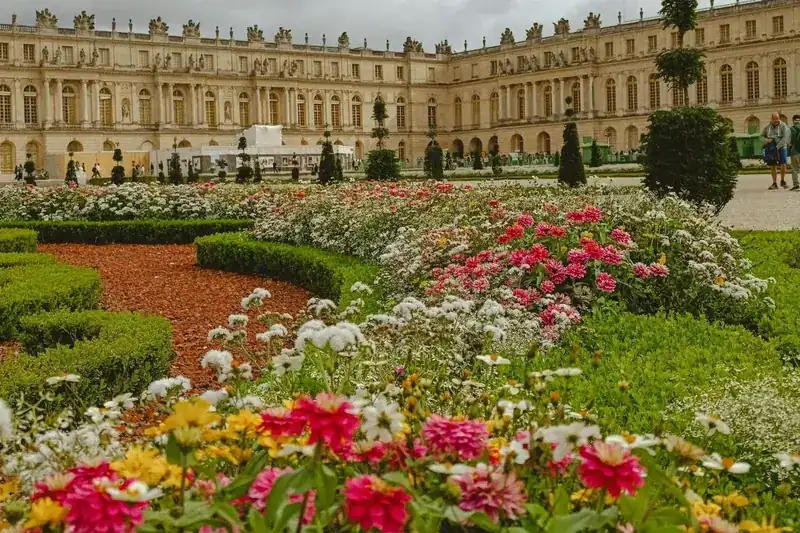
The Palace and her Trianon retreat sit about a 30-minute walk apart, so following her story means planning both halves of the day. If you want a guide for both, the Palace, Gardens & Queen’s Estate guided tour covers the King’s and Queen’s State Apartments and the Hall of Mirrors, then includes entry to the Petit Trianon, the Grand Trianon and the Queen’s Hamlet. It runs from $166 and is rated 4.9/5 from more than 450 reviews. Guided-visit programmes and ticket conditions change, so confirm what is open on your date before you pay.
Marie Antoinette at Versailles: The Essential Places
If you mainly want to follow Marie Antoinette’s story, prioritise these areas:
- Queen’s State Apartment
- Queen’s Bedchamber
- Marie Antoinette’s Private Chambers
- Petit Trianon
- French and English Gardens at Trianon
- Temple of Love
- Queen’s Theatre
- Queen’s Hamlet
You do not need to see all of them to understand her connection with Versailles, but together they show the contrast between her official and private lives.
Who Was Marie Antoinette?
Marie Antoinette was born Maria Antonia of Austria in 1755, the daughter of Empress Maria Theresa and Emperor Francis I.
At the age of 14, she was sent to France to marry the future Louis XVI as part of a diplomatic alliance between Austria and France.
She arrived at Versailles in 1770.
When Louis XV died in 1774, her husband became King Louis XVI and Marie Antoinette became Queen of France.
She was only 18.
The transition was difficult. Marie Antoinette had grown up at the Habsburg court in Vienna, where ceremonial rules were less elaborate than at Versailles.
French court life was governed by a complicated system of rank and etiquette. Everyday activities such as dressing, eating and receiving visitors could become public rituals involving members of the court.
Marie Antoinette increasingly looked for places where she could escape those formalities.
That is one reason the Petit Trianon became so important to her.
Other experiences you might enjoy
Beyond her rooms, you can cycle the Gardens of Versailles, row on the Grand Canal, catch the Musical Fountains or add Monet’s Giverny to a day from Paris. Tours around Versailles are below.
Where Did Marie Antoinette Live at Versailles?
Marie Antoinette used several different spaces within Versailles.
Her principal official residence was the Queen’s State Apartment in the main Palace.
Behind those rooms were smaller private chambers, which allowed the Queen a greater degree of privacy.
She also used additional rooms on other floors of the château.
Outside the main Palace, she spent considerable time at the Petit Trianon, which Louis XVI gave her in 1774.
The Petit Trianon and its surrounding gardens became the part of Versailles most closely associated with her personal tastes.
So there is no single answer to “Where did Marie Antoinette live at Versailles?”
Her life was divided between:
- the ceremonial Palace
- private rooms behind the State Apartment
- the Petit Trianon
- the gardens and buildings of her Trianon retreat
The Queen’s State Apartment
Inside the Palace, Marie Antoinette occupied the traditional Queen’s State Apartment, which sits on the opposite side of the Hall of Mirrors from the King’s apartments.
These rooms were not created specifically for her. Earlier queens and royal women had occupied and altered them before her.
The State Apartment was where the Queen performed the official role expected of her at court.
It included spaces connected with:
- public ceremonies
- dressing rituals
- formal audiences
- receiving courtiers
- dynastic life
The most famous room is the Queen’s Bedchamber.
Marie Antoinette’s Bedroom at Versailles
The Queen’s Bedchamber is one of the most important rooms connected with Marie Antoinette inside the main Palace.
Its importance was both personal and political.
Royal births took place here in public according to court tradition. Marie Antoinette gave birth to her children in this room.
The bedroom was also part of the elaborate daily ritual of Versailles court life.
For the Queen, getting dressed could involve a strict hierarchy determining which woman of the court was entitled to hand her particular items of clothing.
This kind of etiquette helps explain why Marie Antoinette later valued the relative privacy of Trianon.
Did Marie Antoinette Escape Through a Secret Door?
There is a famous story that Marie Antoinette escaped through a hidden door in her bedroom when a crowd entered Versailles during the October Days of 1789.
There is truth behind the story, although “secret passage” can make it sound more dramatic than it was.
The Queen’s Bedchamber had discreet access to the private rooms behind the State Apartment.
During the crisis of 5–6 October 1789, Marie Antoinette was able to leave the bedroom and reach the King’s side of the Palace through the internal circulation of the royal apartments.
When you visit the room today, this connection between ceremonial spaces and hidden private rooms is easy to overlook.
Marie Antoinette’s Private Chambers
Behind the Queen’s State Apartment lies a much more intimate sequence of rooms known as Marie Antoinette’s Private Chambers.
These rooms are especially valuable because they show a side of the Queen that the grand State Apartment does not.
The chambers were used for:
- reading
- private conversation
- writing
- personal collections
- music
- relaxation
- receiving selected visitors
Marie Antoinette modified and redecorated these spaces repeatedly according to her changing tastes.
The private chambers extended across more than one level and looked toward small internal courtyards instead of the enormous formal gardens.
The difference in scale is striking.
The State Apartment was about monarchy and ceremony.
The private chambers were about trying to create personal space inside a Palace where true privacy was difficult.
What Can You See in Marie Antoinette’s Private Chambers?
Important rooms include spaces such as the:
- Méridienne Room
- Library
- Gold Room
- Billiard Room
- smaller private and service rooms
The decoration is more delicate and personal than the monumental rooms of the State Apartments.
Floral motifs, refined woodwork, textiles and furniture help reveal Marie Antoinette’s interest in interior decoration and fashion.
The lower-floor private rooms include areas created or altered specifically for her, while upper rooms were used to expand the limited private space available behind the Queen’s official apartment.
The Méridienne Room
The Méridienne Room is one of the most famous spaces in the Queen’s private apartments.
It was redesigned for Marie Antoinette in the early 1780s.
The room takes its name from a type of daybed associated with midday rest.
Its scale and decoration make it feel very different from the Queen’s public bedchamber.
Instead of projecting power toward hundreds of courtiers, the space was designed for personal use.
It is one of the clearest places to appreciate the Queen’s preference for more intimate interiors.
Marie Antoinette’s Library
Books were an important part of Marie Antoinette’s private world.
Her library at Versailles was fitted with adjustable shelving hidden within elegant cabinetry.
As her book collection grew, the library had to be extended.
She also maintained a library at Trianon.
The room challenges the simplified image of Marie Antoinette as someone interested only in clothing, parties and luxury.
Her private apartments reveal a much broader personal environment.
The Gold Room
The Gold Room forms another important part of Marie Antoinette’s private chambers.
The room had existed before her reign but was modified repeatedly and adapted to her tastes.
Like many private royal interiors at Versailles, its history is layered: different queens used and altered these spaces over time.
Visitors should therefore be cautious about imagining that everything now visible belonged exclusively to Marie Antoinette.
Versailles was continuously changed by successive occupants.
Can You Visit Marie Antoinette’s Private Chambers?
Yes, but they are not always part of the standard self-guided route through the Palace.
Access is typically offered through dedicated guided visits or specific visitor programmes.
This is an important distinction.
A standard Palace ticket allows you to see the major State Apartments, including the Queen’s Bedchamber, but it does not necessarily mean you will enter every small private room associated with Marie Antoinette.
None of the GetYourGuide tours featured on this site lists the Private Chambers among its inclusions; they follow the State Apartments route. If her private life is a major reason for your visit, check the château’s current guided-tour programme before booking.
Why Did Marie Antoinette Want More Privacy?
Life at Versailles could be extraordinarily public.
The French court operated through a culture in which proximity to the monarch created status.
That meant nobles competed for the right to be present during ordinary royal routines.
For Marie Antoinette, this included ceremonies surrounding:
- waking
- dressing
- meals
- audiences
- childbirth
She had grown up in a different court culture and often found Versailles etiquette restrictive.
Her search for greater privacy explains both her adaptation of the small rooms behind her State Apartment and her attachment to the Petit Trianon.
Petit Trianon: Marie Antoinette’s Retreat
The Petit Trianon is the place most strongly associated with Marie Antoinette outside the main Palace. Our Trianon Estate guide covers it alongside the Grand Trianon, sight by sight.
However, she did not build it.
It was commissioned during the reign of Louis XV and completed in 1768.
The building was closely connected with Louis XV’s interest in botanical science and the gardens he had developed in the area.
When Louis XVI became king in 1774, he gave the Petit Trianon to Marie Antoinette.
She was 18 years old.
From that point, the estate became deeply associated with her personal life.
Why Did Louis XVI Give Marie Antoinette the Petit Trianon?
The gift gave the young Queen something extremely valuable at Versailles: a place where she could establish her own social environment.
At the Petit Trianon, access was more restricted than in the main Palace.
Marie Antoinette could choose her companions and reduce the elaborate ceremonial hierarchy that governed life at court.
This inevitably created resentment.
Members of the aristocracy who expected access to the Queen could feel excluded from the intimate circle around Trianon.
What Marie Antoinette experienced as privacy could be interpreted by others as rejection.
That tension became part of the criticism directed against her.
What Is Inside the Petit Trianon?
The Petit Trianon is a compact neoclassical château.
Its rooms are much smaller than the State Apartments in the main Palace.
Visitors can see interiors connected with successive occupants of the building, including Marie Antoinette and later historical figures.
The attraction is not simply individual pieces of furniture.
The building makes sense when you compare it with the main Palace.
After walking through the enormous ceremonial rooms at Versailles, the Petit Trianon feels strikingly restrained.
Its scale helps explain why Marie Antoinette valued it.
Marie Antoinette and the Trianon Gardens
Marie Antoinette did not limit her changes to the Petit Trianon building.
She reshaped the surrounding landscape.
Beginning in the late 1770s, the existing gardens were transformed in accordance with the fashionable taste for more naturalistic English-style landscape gardens.
This was very different from the formal French Gardens created by André Le Nôtre near the main Palace, which our Versailles gardens guide walks through grove by grove.
Instead of:
- straight avenues
- strict symmetry
- geometric parterres
- monumental axes
the new landscape emphasised:
- winding paths
- irregular planting
- water
- carefully composed “natural” views
- small architectural features
- changing scenery
The result looks spontaneous, but it was carefully designed.
French Garden vs English Garden at the Petit Trianon
Both styles can be seen around the Petit Trianon.
French Garden
The French Garden retains a more ordered layout.
Expect:
- symmetry
- formal flower beds
- straight paths
- carefully organised planting
English Garden
The English Garden deliberately creates the impression of natural scenery.
Expect:
- curved paths
- irregular vegetation
- water
- picturesque viewpoints
- architectural follies
Walking from one style into the other is one of the best ways to understand changing 18th-century tastes.
The Temple of Love
One of the most recognisable features of the Trianon gardens is the Temple of Love.
The small classical structure stands on an island and forms part of the romantic landscape created around the Petit Trianon.
Its circular colonnade surrounds a sculpture of Cupid.
The temple is visually simple but carefully positioned.
Like many features in English-style landscape gardens, it was designed to appear unexpectedly within a composed natural setting.
It remains one of the most photogenic locations associated with Marie Antoinette at Versailles.
The Belvedere
The Belvedere is another elegant garden structure linked with Marie Antoinette’s landscape at Trianon.
Set within the English Garden, it was designed by Richard Mique, the Queen’s architect.
The building combines refined classical architecture with the deliberately informal scenery of the surrounding garden.
It was used for music and intimate entertainment.
Together with the Temple of Love, the grotto and water features, it helped create a private world very different from the formal court.
Marie Antoinette’s Grotto
Artificial grottoes were fashionable features in 18th-century landscape gardens.
Marie Antoinette’s garden included one near the Belvedere.
Its irregular rockwork and concealed viewpoints added to the impression of a landscape shaped by nature instead of architecture.
The effect was carefully staged.
These spaces were designed to produce surprise, intimacy and picturesque views as visitors moved through the garden.
The Queen’s Theatre
Marie Antoinette was passionate about theatre.
She watched performances and also acted in private productions.
In 1780, a small theatre designed by Richard Mique was inaugurated near the Petit Trianon.
From the outside, the building is intentionally discreet.
Inside, it is much more elaborate.
The theatre could accommodate around 250 spectators and used clever economical materials to create the appearance of luxury.
Decorative elements imitating marble and rich ornament allowed the interior to look lavish without using expensive materials everywhere.
The theatre is especially important because it survives remarkably intact.
Can You Visit the Queen’s Theatre?
The exterior can be encountered while exploring the Trianon area, but the interior is not normally part of standard admission.
Interior access is offered through specific guided tours.
If seeing the theatre inside is important to you, check the official guided-tour schedule before your visit.
Do not assume a Passport or Trianon ticket automatically includes entry to every interior space.
The Queen’s Hamlet
The Queen’s Hamlet, known in French as the Hameau de la Reine, is probably the most famous part of Marie Antoinette’s private estate.
In 1783, she asked Richard Mique to extend the Trianon gardens northward and create a picturesque village around an artificial lake.
Construction continued until 1786.
The resulting hamlet included rustic-looking cottages arranged around the water.
Today, it feels almost completely removed from the monumental formality of the Palace of Versailles.
Why Did Marie Antoinette Build the Queen’s Hamlet?
The hamlet reflected a fashionable late-18th-century fascination with:
- rural scenery
- pastoral imagery
- nature
- picturesque architecture
- idealised country life
Marie Antoinette used the area for walks, entertaining selected guests and family life.
The estate also had an educational function for her children.
Part of the hamlet was connected with a functioning farm.
The combination of real agricultural activity and theatrical rustic architecture is one reason the Queen’s Hamlet is frequently misunderstood.
What Buildings Are in the Queen’s Hamlet?
The hamlet was arranged around a lake and divided into areas with different functions.
Buildings included structures such as:
- the Queen’s House
- billiard room
- boudoir
- warming room
- mill
- dairy buildings
- farm-related structures
The rustic exteriors were deliberately picturesque.
Some buildings served genuine practical purposes, while others were intended for leisure, entertaining or aesthetic effect.
Not all original structures survive in exactly the same state.
Did Marie Antoinette Pretend to Be a Peasant?
This is one of the most persistent myths about her.
The popular image is that Marie Antoinette dressed as a shepherdess and pretended to be a poor farmer while ignoring the real suffering of French peasants.
The reality is more complicated.
The Queen’s Hamlet was undoubtedly an aristocratic, idealised version of rural life. It was created for one of the richest royal courts in Europe and should not be mistaken for an ordinary French village.
However, the claim that Marie Antoinette routinely dressed as a peasant and personally performed farm labour is an oversimplification.
The estate included a working farm, but the Queen’s use of the hamlet focused on leisure, private social life, walking and family activities.
It is better understood as a fashionable pastoral retreat than as a place where she literally tried to live as a peasant.
Did Marie Antoinette Milk Cows at the Hamlet?
Stories about Marie Antoinette personally milking cows are often repeated as fact.
There is no need to rely on that image to understand the hamlet.
The important point is that the estate combined an idealised rural setting with genuine agricultural activity.
Marie Antoinette did not need to spend her days performing farm labour for the hamlet to express the era’s fascination with a simpler, supposedly more natural way of life.
The Queen’s House
The Queen’s House was the central private building in the hamlet.
It consisted of connected sections and gave Marie Antoinette a place to receive selected guests.
The interiors visitors see today reflect later restoration and refurnishing as well as the complicated history of the building after the Revolution.
This is an important point throughout Versailles.
Rooms associated with Marie Antoinette may contain reconstructed decoration, restored elements or furniture from later occupants.
The historical setting remains meaningful, but it should not always be interpreted as a perfectly untouched 1780s interior.
Can You Go Inside the Queen’s House?
The grounds of the Queen’s Hamlet can be visited as part of the Trianon Estate.
However, the interior of the Queen’s House is accessible only through specific guided visits under current visitor arrangements.
If your priority is seeing the interior and not only exploring the hamlet from outside, check availability before your trip.
If the Petit Trianon and the hamlet grounds are what you came for, the Marie Antoinette Petit Trianon & Estate tour is a two-hour guided visit of the Petit Trianon, her gardens and the hamlet, with the hamlet seen from outside, as its listing states. It starts at the bottom of the gardens, so you either need a garden ticket or can walk in free through the Queen’s Gate into the park. It runs from $51 and is rated 4.7/5 from more than 90 reviews.
Marie Antoinette’s Children at Versailles
Marie Antoinette and Louis XVI had four children:
- Marie Thérèse Charlotte
- Louis Joseph
- Louis Charles
- Sophie Hélène Béatrice
The Queen was more involved in family life than older stereotypes of Versailles queens sometimes suggest.
The Trianon Estate gave the royal family more opportunities for private time away from the rigid ceremonial environment of the Palace.
The Queen’s Hamlet and farm were also connected with the education of the royal children.
Understanding that family dimension makes Trianon feel less like a collection of decorative buildings and more like an alternative royal environment.
Marie Antoinette and Fashion at Versailles
Fashion was central to Marie Antoinette’s public image.
Her clothing and hairstyles attracted enormous attention at court.
She worked with the famous dressmaker Rose Bertin, sometimes described as her “Minister of Fashion”.
Her choices could create trends, but they also attracted criticism.
Lavish clothing helped strengthen an image of extravagance at a time when the monarchy’s finances were increasingly controversial.
Ironically, Marie Antoinette later embraced simpler fashions, including light white dresses associated with a more informal ideal of natural life.
Those styles were also criticised.
The Queen’s appearance had become political.
Was Marie Antoinette Responsible for France’s Financial Crisis?
No.
Marie Antoinette certainly spent heavily by ordinary standards and became a convenient target for criticism.
But France’s financial crisis was caused by much larger structural problems, including:
- long-term state debt
- expensive wars
- inefficient taxation
- resistance to fiscal reform
- government borrowing
- the cost of supporting the American Revolution
Calling Marie Antoinette the cause of France’s bankruptcy seriously oversimplifies the problem.
Her reputation for extravagance mattered politically because it became a symbol of wider anger toward the monarchy.
Did Marie Antoinette Say “Let Them Eat Cake”?
There is no reliable evidence that she said it.
The phrase is traditionally rendered as:
“Let them eat cake.”
The French wording usually associated with the story is “Qu’ils mangent de la brioche.”
Versions of the anecdote circulated before Marie Antoinette became Queen and were attached to different royal figures.
Jean-Jacques Rousseau referred to a similar story in his Confessions without naming Marie Antoinette.
The quotation became attached to her later because it suited the revolutionary image of an out-of-touch queen.
It remains one of history’s most famous misattributions.
Why Was Marie Antoinette So Unpopular?
Her unpopularity developed for many reasons.
She was:
- foreign-born
- associated with Austria
- highly visible
- linked with court luxury
- criticised for her private social circle
- targeted by scandalous pamphlets
- blamed for political influence she did not always possess
Her life at the Petit Trianon also created resentment because restricting access to the Queen disrupted the social expectations of court nobles.
Later scandals, including the Affair of the Diamond Necklace, damaged her reputation even though she was not responsible for the fraud.
By the final years of the monarchy, Marie Antoinette had become a political symbol onto which many different grievances were projected.
What Happened to Marie Antoinette at Versailles in 1789?
Versailles ceased to be the main royal residence after the events of 5–6 October 1789.
Crowds marched from Paris to Versailles amid anger over bread shortages and political tensions.
After violence inside the Palace, Louis XVI, Marie Antoinette and their family were forced to leave Versailles for Paris.
They moved to the Tuileries Palace.
Marie Antoinette would never return to live at Versailles.
The departure effectively ended the château’s role as the permanent seat of the French royal court.
What Happened to the Petit Trianon After Marie Antoinette?
The Revolution transformed Versailles.
Furniture and royal possessions were dispersed.
The Trianon buildings survived but were later occupied and redecorated under subsequent regimes.
One notable later occupant was Empress Marie Louise, the second wife of Napoleon I.
This is why some interiors at the Petit Trianon include objects and decorative schemes associated with periods after Marie Antoinette.
Versailles is not a snapshot of one moment. It is a historical site with layers extending far beyond the reign of Louis XVI.
Is Marie Antoinette Buried at Versailles?
No.
After the fall of the monarchy, Marie Antoinette was imprisoned in Paris.
She was executed by guillotine on 16 October 1793 at what is now the Place de la Concorde.
Her remains were initially buried in the Madeleine cemetery.
During the Bourbon Restoration, the remains identified as those of Louis XVI and Marie Antoinette were transferred to the Basilica of Saint-Denis, the traditional burial church of French monarchs.
So visitors looking for Marie Antoinette’s tomb should go to Saint-Denis, not Versailles.
How Much Time Do You Need for Marie Antoinette’s Versailles?
If you want more than a quick look at the Queen’s Bedroom, allow most of a day.
A useful breakdown is:
- Queen’s State Apartment: 20–30 minutes within the main Palace route
- Private Chambers guided visit: typically around 1–1.5 hours, depending on programme
- journey across the estate to Trianon: 30 minutes or more
- Petit Trianon: 30–45 minutes
- English Garden: 30 minutes
- Queen’s Hamlet: 45–60 minutes
A Marie Antoinette-focused visit can easily fill half a day after the main Palace. If you are coming from Paris for it, our Versailles day trip guide compares a full day by train with a guided tour.
Best Marie Antoinette Route at Versailles
For a full-day visit, use this order:
1. Main Palace
Follow the standard route through the State Apartments.
Pay particular attention to the Queen’s Bedchamber.
2. Marie Antoinette’s Private Chambers
If you have booked a dedicated guided visit, schedule it around your main Palace entry.
3. Gardens
Walk west through the formal gardens toward the wider estate.
4. Petit Trianon
Explore the building that became Marie Antoinette’s private retreat.
5. French and English Gardens
Move from the formal landscape into the naturalistic garden she developed.
6. Queen’s Theatre and Temple of Love
See the major architectural features around the Petit Trianon.
7. Queen’s Hamlet
Finish in the most distinctive part of her private estate.
This route moves from public queen → private queen → private landscape.
It is the clearest way to understand why Trianon mattered so much to her.
Can You Visit Only the Marie Antoinette Estate?
Yes.
If you have already visited the main Palace on another trip, you can focus on the Estate of Trianon.
A dedicated Trianon ticket normally covers:
- Grand Trianon
- Petit Trianon
- their gardens
- Queen’s Hamlet
The Trianon Estate typically opens later than the main Palace, so it works well as an afternoon visit.
Always check current opening dates and ticket conditions before travelling.
Which Ticket Is Best for a Marie Antoinette Visit?
Your best ticket depends on what you want to see. Our Passport vs Palace ticket guide has the current prices for each.
Palace Ticket
Choose this if you mainly want:
- Queen’s State Apartment
- Queen’s Bedchamber
- main Palace interiors
Estate of Trianon Ticket
Choose this if you mainly want:
- Petit Trianon
- Trianon gardens
- Queen’s Hamlet
- Grand Trianon
Passport
Choose this for the most complete visit:
- Palace
- Gardens
- Trianon Estate
On GetYourGuide, the Palace and Gardens Full Access Ticket covers the same ground: timed palace entry plus a day’s access to the whole domain, including Marie Antoinette’s estate and the Trianon. It is sold from $29, carries no guide, and is rated 4.6/5 from more than 47,000 reviews.
Guided Visits
Some of the most interesting Marie Antoinette interiors require specific guided-tour reservations, including certain private rooms and the interiors of buildings that are not open on the standard route.
Check these separately from general admission.
Is the Petit Trianon Included in the Versailles Passport?
Yes, the Passport is designed to cover the wider Versailles estate, including the Trianon Estate.
However, this does not mean every restricted interior is automatically open.
Certain spaces may still require a guided tour or separate reservation.
Is the Queen’s Hamlet Included?
Access to the Queen’s Hamlet grounds is included with admission to the Trianon Estate.
Interior access to the Queen’s House is more restricted and currently requires a guided visit.
Know this before you arrive, so the hamlet does not disappoint.
Best Time to Visit Marie Antoinette’s Estate
The Trianon Estate is particularly pleasant from spring through early autumn.
Reasons include:
- longer daylight
- greener landscapes
- flowers
- comfortable walking between buildings
- better experience of the English Garden
- more time to explore the hamlet
Winter can still be atmospheric and significantly quieter.
If your main interest is interiors and history more than gardens, the lower visitor numbers can be a major advantage. Our guide to avoiding crowds at Versailles covers the best days and hours.
Is Marie Antoinette’s Estate Crowded?
Usually less than the main Palace.
Nearly every Versailles visitor enters the State Apartments and Hall of Mirrors.
Far fewer continue all the way to the Petit Trianon and Queen’s Hamlet.
The Trianon area can still be busy in peak season, but the atmosphere generally feels calmer because visitors are spread across a much larger landscape.
If you find the Palace overwhelming, the change of pace can be one of the highlights of the day.
Can You Walk from the Palace to the Petit Trianon?
Yes.
However, Versailles is much larger than many first-time visitors expect.
Walking from the Palace through the gardens and park toward Trianon can take around 30 minutes, depending on your route and pace.
Other options include:
- the little train
- electric vehicles available for hire under current conditions
If you are planning a Marie Antoinette-focused day, do not underestimate the travel time between the Palace and Trianon.
Some visitors solve the distance on two wheels. The Versailles Palace and Queen Hamlet E-Bike Tour rides out from Paris through the Parc de Saint-Cloud, then gives you the Palace at your own pace and a visit to the Queen’s Hamlet. It runs from $193 and is rated 4.9/5 from more than 140 reviews; one reviewer put the day at about 20 miles of riding, so it suits people who are comfortable on a bike.
Is the Queen’s Hamlet Worth Visiting?
Yes, particularly if you are interested in Marie Antoinette.
The Hamlet adds an essential dimension to the story because it shows how far her private world at Trianon moved away from the formality of the main Palace.
It also helps explain why the Queen attracted both fascination and criticism.
The setting is beautiful, but it is more interesting when you understand the social and political context behind it.
Allow enough time to walk around the lake and view the buildings instead of treating it as a quick photo stop.
Petit Trianon or Queen’s Hamlet: Which Should You Choose?
If you only have time for one, choose based on your interests.
Choose Petit Trianon if you prefer:
- interiors
- architecture
- royal history
- seeing where Marie Antoinette stayed
Choose Queen’s Hamlet if you prefer:
- gardens
- photography
- outdoor walking
- picturesque architecture
- the more unusual side of Versailles
Ideally, see both.
They were parts of the same private landscape and make much more sense together.
Palace or Trianon for Marie Antoinette?
Again, both tell different parts of the story.
Main Palace
Best for understanding:
- royal ceremony
- public expectations
- court etiquette
- the Queen’s official role
- the events of October 1789
Trianon
Best for understanding:
- privacy
- personal taste
- friendship circles
- landscape design
- theatre
- family life
- the image Marie Antoinette tried to create away from court
If you want to understand why she found Versailles so difficult, the contrast between the two is more valuable than either place alone.
Common Marie Antoinette Myths to Avoid
“She built the Petit Trianon.”
False.
The Petit Trianon was completed under Louis XV before Marie Antoinette became Queen.
“She built the whole Trianon Estate.”
False.
Trianon existed long before her. She transformed parts of the Petit Trianon landscape and commissioned major additions such as the Queen’s Hamlet.
“She said ‘Let them eat cake.’”
There is no reliable evidence that she did.
“She spent her days pretending to be a poor peasant.”
An oversimplification.
The Queen’s Hamlet was an aristocratic pastoral retreat with a working farm, not a place where she literally adopted the life of an ordinary peasant.
“Marie Antoinette bankrupted France.”
False.
Royal spending contributed to the monarchy’s image problem, but France’s financial crisis had much deeper structural and geopolitical causes.
“Everything in her rooms today belonged to her.”
Not necessarily.
Versailles has undergone revolution, dispersal, restoration and later reoccupation. Some interiors contain reconstructed or later furnishings.
Frequently Asked Questions
Where are Marie Antoinette’s rooms at Versailles?
Her official rooms are within the Queen’s State Apartment in the main Palace. Her smaller private chambers lie behind and above those ceremonial rooms.
Can you see Marie Antoinette’s bedroom?
Yes. The Queen’s Bedchamber is part of the main Palace route.
Can you visit Marie Antoinette’s private rooms?
Yes, but the private chambers are generally accessed through specific guided visits, not simply as part of every standard Palace visit.
Did Marie Antoinette live at the Petit Trianon?
She used the Petit Trianon as an important private retreat after Louis XVI gave it to her in 1774.
Did Marie Antoinette build the Petit Trianon?
No. It was commissioned during the reign of Louis XV and completed in 1768.
What is Marie Antoinette’s village at Versailles?
It is the Queen’s Hamlet, a picturesque group of rustic-looking buildings arranged around a lake in the Trianon gardens.
Why did Marie Antoinette build the Queen’s Hamlet?
It reflected the late-18th-century fashion for pastoral landscapes and nature. She used it for walks, private gatherings and family life, while part of the estate functioned as a farm.
Did Marie Antoinette actually live in the Queen’s Hamlet?
The Hamlet was primarily a retreat and leisure setting, not her principal residence. The Petit Trianon was the central residence associated with her private estate.
Can you go inside Marie Antoinette’s house in the Hamlet?
The Queen’s House interior is not normally included in standard access and is currently visited through dedicated guided tours.
Can you visit the Queen’s Theatre?
The exterior can be seen in the Trianon area, while interior access is limited to specific guided visits.
How long should I spend at the Petit Trianon and Queen’s Hamlet?
Allow around 2 hours for a comfortable visit to the Petit Trianon, gardens and Queen’s Hamlet. Add more time if you want to explore slowly or include the Grand Trianon.
Is Marie Antoinette buried at Versailles?
No. She is buried at the Basilica of Saint-Denis near Paris.
Did Marie Antoinette say “Let them eat cake”?
There is no credible evidence that she did. The phrase was associated with similar stories before it became attached to her name.
Is the Marie Antoinette Estate included in Versailles tickets?
The Trianon Estate is included with the Versailles Passport and can also be visited with a dedicated Trianon ticket. Restricted interiors and guided tours can require additional booking.
Final Thoughts
The best way to understand Marie Antoinette at Versailles is to follow her from the main Palace to Trianon.
Inside the Palace, the Queen’s Bedchamber and State Apartment show a life shaped by ceremony, hierarchy and constant observation.
Behind those public rooms, the private chambers reveal her attempts to create personal space.
Then, at the Petit Trianon, the scale changes completely.
The architecture becomes smaller. The gardens become less formal. The Queen’s Theatre, Temple of Love and English Garden lead gradually toward the Queen’s Hamlet, a landscape designed around intimacy, nature and carefully controlled privacy.
That contrast is the real story.
Marie Antoinette did not simply “escape” Versailles by leaving the Palace. She created another Versailles within it — one that reflected her own tastes and her discomfort with the public role she had been expected to perform.
If you have time for only the main château, make sure you see the Queen’s Bedchamber.
But if Marie Antoinette is one of your main reasons for visiting Versailles, continue to the Petit Trianon and Queen’s Hamlet.
Without them, you see the public Queen.
With them, you begin to understand the person she was trying to be when the court was no longer watching.
Walk the Hall of Mirrors — Without the Line
Join 11,869+ guests who rated this Versailles palace tour 4.7/5. Skip-the-line entry, a 90-minute licensed guide, and full gardens access — with free cancellation.
Check Availability & Book