Rooms Inside the Palace of Versailles: What to See and What Not to Miss
Room by room through the Palace of Versailles: the State Apartments, Hall of Mirrors, King's and Queen's Bedchambers, private apartments, Royal Chapel and Opera, and how long to allow.
The rooms inside the Palace of Versailles each had a job, and knowing it is what makes the gold and marble readable. Some rooms staged royal ceremony. Others controlled who could reach the king. Some hosted concerts, games, diplomatic receptions or formal meals. Behind the grand public apartments sat smaller private rooms where kings and queens tried to get away from the court they had built around themselves.
On a first visit, the rooms you should not miss are the Hall of Mirrors, the King’s State Apartment, the King’s Bedchamber, the Queen’s Bedchamber, the War Room and the Peace Room. Some of the most interesting interiors, including the King’s Private Apartments, Marie Antoinette’s private rooms, the Royal Opera and parts of the Royal Chapel, are often off the unaccompanied route and need a guided visit. This guide walks through the major rooms, what each was used for, which to prioritize, how long to allow and which special-access rooms are worth booking separately.
Important: Versailles regularly closes individual rooms for conservation, restoration, events or crowd management, and the visitor route can change. Check the château’s information for your date before counting on any room listed here.
A guide makes the difference between “another gilded room” and knowing why courtiers fought to stand in it. The Versailles: Skip-the-Line Tour of Palace and Gardens Access takes you through the State Apartments, the King’s Bedchamber and the Hall of Mirrors with a licensed guide for 90 minutes, then leaves you free in the Gardens, from $80 and rated 4.7/5 from more than 12,000 reviews. Check the time slots left for your date here.
Best Rooms at Versailles: Quick List
If your time is limited, prioritize these:
| # | Room | Why see it | On the standard route? |
|---|---|---|---|
| 1 | Hall of Mirrors | 73 meters, 357 mirrors, the 1919 treaty | Yes |
| 2 | King’s Bedchamber | The king’s rising and going to bed as state ritual | Yes |
| 3 | Apollo Room | Louis XIV’s Throne Room | Yes |
| 4 | Hercules Room | Lemoyne’s ceiling and Veronese’s painting | Yes |
| 5 | Queen’s Bedchamber | Public royal births, Marie Antoinette’s escape in 1789 | Yes, when the apartment is open |
| 6 | War Room | Louis XIV on horseback, the way into the Hall | Yes |
| 7 | Peace Room | The Hall’s counterpart on the Queen’s side | Yes |
| 8 | Mercury Room | Where Louis XIV lay in state in 1715 | Yes |
| 9 | Royal Chapel | Two-level chapel completed in 1710 | Seen from the route; fuller access varies |
| 10 | King’s Private Apartments | The kings’ studies, libraries and dining rooms | Guided visit only |
For first-time visitors the château recommends at least 1.5 hours for the main highlights; 2 hours is more comfortable.
Other experiences you might enjoy
Once you have seen the State Apartments, you can cycle out to the Grand Canal, tour Marie Antoinette’s Trianon and Queen’s Hamlet, or pair Versailles with Paris and Giverny.
How Is the Palace of Versailles Organized?
The Palace is not laid out like a modern museum with themed galleries. Its rooms grew over generations. The main visitor areas are:
- the King’s State Apartment
- the Hall of Mirrors
- the War Room
- the Peace Room
- the King’s Apartment
- the Queen’s State Apartment
- the private royal apartments
- the Royal Chapel
- the Royal Opera
- the historical galleries added in the 19th century
The easiest way to make sense of the château is to separate the ceremonial rooms from the private rooms.
State Apartments vs Private Apartments
State Apartments
These were built for ceremony, representation, court gatherings, official receptions and royal display. They are large and richly decorated.
Private Apartments
These were for working, reading, private dining, sleeping, collections and personal life. They are usually smaller and more intimate.
The contrast is one of the most interesting things about Versailles: monarchy looks magnificent in public and surprisingly human in private.
The King’s State Apartment
The King’s State Apartment is a core part of the standard Palace visit: a run of ceremonial salons decorated in a lavish, Italian-inspired style. Louis XIV used them for court entertainment and public display, not as ordinary living space.
The seven main rooms in the sequence are:
- Hercules Room
- Abundance Room
- Venus Room
- Diana Room
- Mars Room
- Mercury Room
- Apollo Room
Each has its own symbolism and function.
1. Hercules Room
The Hercules Room is one of the largest and most impressive rooms in the Palace, and the last major room added to Louis XIV’s State Apartment. The space was once part of an earlier Palace chapel; after the present Royal Chapel was finished in 1710, the old chapel could be turned into a ceremonial room.
What to Look For
Look up first. The ceiling painting, The Apotheosis of Hercules by François Lemoyne, fills the vault with a crowd of mythological figures and was meant to rival the great decorated ceilings of Italy.
Then find the huge canvas The Meal in the House of Simon by Paolo Veronese, a gift from the Republic of Venice to Louis XIV.
Why It Matters
The Hercules Room shows Versailles still growing after Louis XIV’s great building campaigns, and its size makes an immediate impression before you move deeper into the State Apartments.
2. Abundance Room
The Abundance Room is smaller than the great salons around it. It served as an antechamber where refreshments were set out during evening court entertainments, and it led to the cabinet where Louis XIV kept his most precious collections.
What to Look For
Look at the ceiling. Its decoration celebrates abundance, luxury, royal generosity and precious objects, which suited a room tied to refreshments and the king’s treasures.
Should You Spend Long Here?
No. For most first-time visitors this is a room to understand in passing. Save your time for Apollo, Mercury and the Hall of Mirrors.
3. Venus Room
The Venus Room is named after the Roman goddess Venus. Like the other salons, its decoration links Louis XIV’s monarchy with classical mythology, and the room was an important stage on the ceremonial route through the Palace.
What to Look For
The decoration is marble, painted ceiling scenes, classical references and sculpture, all on the theme of royal magnificence. The architects wanted visitors to feel they were walking through an idealized classical world.
Why the Mythology Matters
The gods were chosen with care. Each salon tied the French monarchy to a quality: beauty, victory, abundance, wisdom, strength or light. Once you know that, the State Apartment is much easier to read.
4. Diana Room
The Diana Room is another mythological salon in the King’s State Apartment, and under Louis XIV it held a billiard table. It is a good example of the gap between official decoration and actual court life: a room could carry a lofty theme and still be used for games.
What to Look For
Look at the ceiling, the marble and the sculpture, above all the famous bust of Louis XIV by Gian Lorenzo Bernini. Bernini was one of the greatest sculptors of 17th-century Europe, and the bust is a key portrait of the king.
5. Mars Room
The Mars Room takes its name from Mars, the Roman god of war. Its military symbolism suited a monarchy obsessed with victory and martial prestige, yet the room was also used for music and evening entertainment.
What to Look For
The decoration shows war, triumph and military glory, while musicians played here during court gatherings. That mix of martial imagery and social life is typical of Versailles: the rooms broadcast power even at a party.
6. Mercury Room
The Mercury Room was first planned as the ceremonial bedchamber of the King’s State Apartment. In practice it was often used for other things, and Louis XIV’s actual ceremonial bedroom ended up elsewhere in the Palace.
What Happened Here?
After Louis XIV died, his body lay in state in the Mercury Room in September 1715. The room went from symbolic bedchamber to a setting for royal mourning.
What to Look For
Find the alcove with the state bed. Its rich textiles show how Versailles used the royal bed itself as a symbol of monarchy. At court, a bed was more than furniture: it marked rank, privilege and ceremonial status.
7. Apollo Room
The Apollo Room is one of the most important rooms in the King’s State Apartment. Apollo was the classical god most closely tied to Louis XIV, who cultivated the image of the Sun King, and Apollo became one of the central symbols of Versailles.
What Was the Room Used For?
The Apollo Room was the Throne Room. A royal throne once stood here under a canopy, which made it one of the most politically charged spaces in the apartment.
What to Look For
Look for the Apollo imagery, the ceiling, the royal portraits and the spot where the throne stood. The room looks fairly compact next to the Hall of Mirrors, but its symbolic weight was enormous.
Why Apollo?
Apollo stood for the sun, order, patronage of the arts, brilliance and authority, all qualities Louis XIV built into his royal image.
The War Room
At the western end of the King’s State Apartment is the War Room, or Salon de la Guerre. It links the State Apartment to the Hall of Mirrors, and its decoration celebrates French military power.
What to Look For
The most dramatic feature is the large oval relief of Louis XIV on horseback, the king as victorious commander. The sculpture and painting around it stress conquest, strength and royal victory, and that political imagery carries on into the Hall of Mirrors.
The Hall of Mirrors
The Hall of Mirrors is the most famous room in the Palace of Versailles. It is about 73 meters long and has 17 windows, 17 mirrored arches and 357 mirrors. The windows look out over the Gardens and the mirrors face them, and that pairing of room and landscape is the key to the design. Our Hall of Mirrors guide covers the room in depth.
Why Was the Hall of Mirrors Built?
The Hall replaced an open terrace between the King’s and Queen’s apartments that was exposed to the weather and impractical. The architect Jules Hardouin-Mansart enclosed it as a gallery from 1678, and it became one of the most famous ceremonial spaces in Europe.
What to Look For
Do not look only at the mirrors.
The Ceiling
Painted by Charles Le Brun, the ceiling celebrates the main events of Louis XIV’s reign.
The Windows
They frame the central perspective through the Gardens.
The Marble
The marble pilasters and decorative details add to the richness of the architecture.
The Perspective
Stand near one end and look down the full 73-meter gallery. It is one of the most dramatic views inside Versailles.
Important Events in the Hall of Mirrors
The room’s place in history grew long after Louis XIV.
1871
The German Empire was proclaimed here after France’s defeat in the Franco-Prussian War.
1919
The Treaty of Versailles was signed here after the First World War.
So the room matters to modern European politics as well as to royal history.
How Long Should You Spend in the Hall of Mirrors?
For most visitors, 10–20 minutes is enough. Do not rush through for a photo, though. Look up, turn to face the Gardens, study the mirrored arches and see the gallery from both ends.
The Peace Room
At the other end of the Hall of Mirrors lies the Peace Room, built as the War Room’s counterpart. Where the War Room celebrates victory, the Peace Room celebrates the benefits of peace.
What to Look For
The decoration shows peace, prosperity, European stability and French leadership. The room belonged to the Queen’s side of the Palace: Queen Marie Leszczyńska held concerts here, and Marie Antoinette later used it too. It makes a natural bridge from the Hall of Mirrors to the Queen’s Apartment.
The King’s Apartment
The King’s Apartment is not the same as the King’s State Apartment. It is the suite around the Marble Courtyard where the king’s daily ceremonies took place. Its main rooms are:
- the King’s Guard Room
- the antechambers
- the Bull’s Eye Antechamber
- the King’s Bedchamber
- the Council Room
Who got how far into these rooms depended on rank and etiquette.
8. King’s Guard Room
The Guard Room marked the formal entrance to the King’s Apartment, and royal guards were posted here. The decoration is plainer than in the State Apartment, which fits a room whose job was practical and ceremonial, not theatrical.
9. Bull’s Eye Antechamber
The Bull’s Eye Antechamber was one of the most important waiting rooms in the royal apartment. It is named after its large oval window, an oeil-de-boeuf, or bull’s eye.
Why It Was Important
Courtiers waited here before they were admitted to the king. The room shows Versailles etiquette in physical form: being let through one door and not another signaled rank and royal favor.
What to Look For
Notice how the room connects the King’s Bedchamber, the Hall of Mirrors and the nearby royal apartments. Its position made it a crossroads of court life.
10. King’s Bedchamber
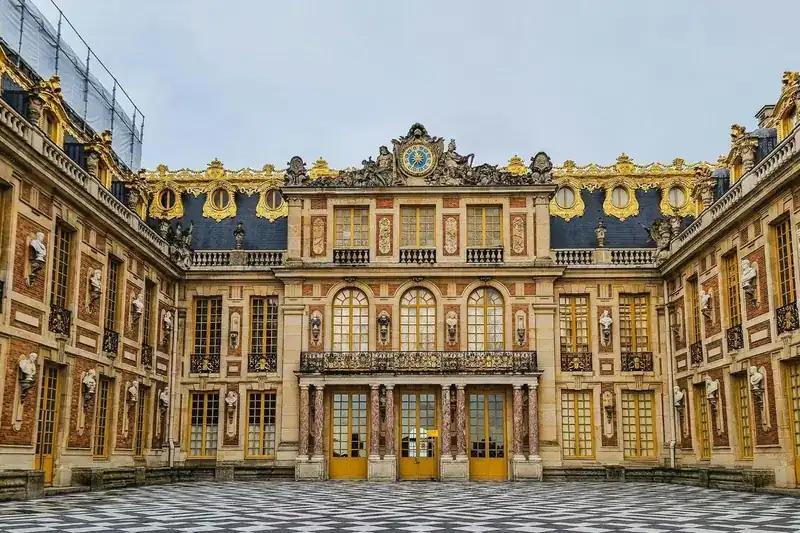
The King’s Bedchamber is one of the most important rooms at Versailles. Louis XIV moved his bedchamber here in 1701, to the middle of the Palace façade. The placement was deliberate: the king sat at the literal center of Versailles.
The Lever and Coucher
The bedroom was the setting for the famous daily ceremonies.
Lever
The king’s ceremonial rising.
Coucher
The king’s ceremonial going to bed.
Different courtiers were let in at different stages, and access became a privilege. A private routine turned into a political ritual.
Louis XIV Died Here
Louis XIV died in this room on 1 September 1715, after a reign of more than 72 years, one of the longest in European history.
What to Look For
Focus on the state bed, the alcove, the textiles, the room’s central position and the religious paintings and portraits. The room may feel surprisingly small after the Hall of Mirrors; notice that contrast.
11. Council Room
The Council Room is next to the King’s Bedchamber. It was a working room, where the king met his ministers and governed.
Why It Matters
Versailles was the seat of government as well as a luxurious home. The Council Room is a reminder that major political decisions were taken a few doors from the rooms used for balls and royal ceremonies.
The Queen’s State Apartment
The Queen’s State Apartment runs along the south side of the Palace. Its layout originally mirrored the King’s State Apartment on the north side, and successive queens redecorated it. Today it is linked above all with Marie-Thérèse, Marie Leszczyńska and Marie Antoinette.
The traditional sequence was:
- Queen’s Guard Room
- Royal Table Antechamber
- Nobles’ Room
- Queen’s Bedchamber
- Peace Room
The modern visitor route can run in the opposite direction to that ceremonial order.
12. Queen’s Bedchamber
The Queen’s Bedchamber is the most important room in the Queen’s Apartment. Several queens slept here, but Marie Antoinette is the name most visitors connect with it.
Royal Births
Royal births took place here in public. That sounds extraordinary today, but succession was political, and witnesses confirmed that a royal child was legitimate. Marie Antoinette gave birth to her children in this room.
The October Days of 1789
The Queen’s Bedchamber is also tied to one of the most dramatic nights of the French Revolution. During the night of 5–6 October 1789, a crowd broke into the Palace. Marie Antoinette escaped from her bedroom through a small internal door toward the King’s apartments, and the royal family left Versailles later that day.
What to Look For
Look for the bed, the floral textiles, the gilding, the doors leading to the private rooms and the ceremonial layout. The decoration reflects modern restoration as well as the changes made by successive queens.
13. Nobles’ Room
The Nobles’ Room is where the Queen held formal audiences. Marie Antoinette had it redecorated during her reign.
Why It Matters
Queens at Versailles had ceremonial duties too. The Queen’s Apartment was part of the political and social machinery of court, not just a home.
14. Royal Table Antechamber
The Royal Table Antechamber was used for formal public dining. Under the court system, royal meals could become ceremonies watched by members of the court and the public. Versailles turned ordinary life into performance, and even a meal could be a political act.
15. Queen’s Guard Room
The Queen’s Guard Room was the formal entrance to the Queen’s Apartment, where the Queen’s guards were posted. It keeps important early decoration. On today’s route it often comes at the end of the Queen’s apartment, because the visitor circuit can run in reverse.
Marie Antoinette’s Private Chambers
Behind the public Queen’s Apartment are smaller rooms tied above all to Marie Antoinette. They are among the most interesting interiors at Versailles, but they are often closed to the self-guided route, and you may need the château’s own guided visit, sold as an extra on top of the Passport, to see them.
Why Are the Private Rooms Different?
Marie Antoinette lived under constant scrutiny. The State Apartment was public and ceremonial; the private rooms let her read, write, receive chosen visitors, rest, collect objects and escape some of the etiquette. The drop in scale is striking.
Important Private Rooms
They include the Méridienne Room, the Library, the Gold Room (Cabinet Doré), private sitting rooms and rooms on the upper floor. The interiors are more delicate and intimate than the State Apartment.
If Marie Antoinette is your main interest, a specialist guided visit to these rooms gives you more than a second pass through the Hall of Mirrors.
The King’s Private Apartments
Behind the monumental public rooms are the King’s Private Apartments, used by Louis XIV, Louis XV and Louis XVI for more personal purposes and developed above all under Louis XV. They held:
- private bedchambers
- studies
- cabinets
- dining rooms
- libraries
- scientific rooms
- collections
Can You Visit the King’s Private Apartments?
Not on an ordinary unaccompanied visit. They open through the château’s guided-tour programs, which you book with the château; no marketplace ticket includes them. This is one of the best reasons to book a specialist Versailles tour.
Why Are They Worth Visiting?
The private apartments show a different side of royal life. The public rooms show the monarchy; the private rooms show the person. They show changing taste, personal hobbies, work routines, scientific interests, private dining and luxury on a smaller scale.
For repeat visitors, they are among the best parts of Versailles.
Louis XV’s Private Bedchamber
Louis XV created a smaller private bedroom because the ceremonial bedchamber was impractical for daily life. The smaller room was easier to heat, more private and more comfortable. Louis XV died there in 1774.
It captures one of the central contradictions of Versailles: the great ceremonial rooms projected power well but were poor places to live.
The Royal Chapel
The Royal Chapel is one of the great architectural interiors of Versailles. The present chapel was completed in 1710, late in Louis XIV’s reign, and it rises through two levels. The king and royal family heard Mass from the upper gallery, while much of the court stood below.
Why the Two Levels Matter
The architecture spelled out hierarchy. The royal family was raised above most of the congregation, so the court’s order held even during worship.
What to Look For
Notice the tall columns, the painted ceiling, the royal gallery, the organ, the vertical scale and the white-and-gold stone. The chapel looks different from many earlier Versailles interiors and points ahead to the lighter style of the 18th century.
Can You Go Inside the Royal Chapel?
It varies. You can usually see the chapel from parts of the standard route, while fuller access depends on guided visits, concerts, special openings and current conservation work. Do not assume every Palace ticket includes free access to the chapel floor.
The Royal Opera
The Royal Opera is one of the most spectacular rooms at Versailles, and many first-time visitors never see it. It was completed under Louis XV and inaugurated in 1770 for the wedding celebrations of the future Louis XVI and Marie Antoinette.
What Makes It Special?
The Opera is famous for its painted wood, finished to imitate marble and other costly materials. That kept the weight and the cost down while giving a lavish effect.
What Was It Used For?
The Royal Opera hosted operas, plays, royal celebrations, major banquets and state events, and its floor could be raised and adapted for different uses.
Can You Visit the Royal Opera?
Not on the standard unaccompanied route. You usually need the château’s guided visit, a performance ticket, a special event or an exceptional opening, all bought from the château; no marketplace tour on our list includes the Opera. If architecture or theater history interests you, it is worth the effort.
The Gallery of Battles
The Gallery of Battles belongs to a much later chapter. King Louis-Philippe created it in the 19th century as part of his Museum of French History.
What Is Inside?
The gallery is lined with huge paintings of French military victories across the centuries. It is one of the largest rooms in the Palace.
Why It Feels Different
The Gallery of Battles was never part of Louis XIV’s ceremonial program. Louis-Philippe wanted Versailles to become a national museum of French history, and the gallery shows that the Palace carries many layers of history.
Should You Prioritize It?
If your time is limited, no: see the royal apartments and the Hall of Mirrors first. With more time, or an interest in military history, see it when it is open.
The Dauphin and Dauphine Apartments
Versailles also holds apartments for members of the royal family beyond the king and queen. The Dauphin was the heir to the throne and the Dauphine his wife, and their apartments show another layer of court hierarchy.
Access to these rooms varies. They matter less on a first visit than the State Apartments, the Hall of Mirrors and the royal bedrooms, but repeat visitors get a lot from them.
Apartments of Louis XV’s Daughters
Louis XV’s daughters also had apartments in Versailles. These rooms show a more domestic side of court life and later 18th-century taste. They are usually a lower priority for first-time visitors, but they show that Versailles housed a whole royal family, not just the monarch.
Which Rooms Are on the Standard Versailles Route?
The standard route changes with conservation work and crowd management. First-time visitors can normally expect the King’s State Apartment, the Hall of Mirrors, the War Room, the Peace Room and the main royal apartments. Other rooms may be open depending on the day. All of them come with the Passport; if you prefer to book through a marketplace, the Paris: Versailles Palace and Gardens Full Access Ticket is the Passport-style ticket, with a set Palace time plus the Gardens and Trianon, from $29 and rated 4.6/5 from more than 48,000 reviews.
Do not plan your whole visit around a minor room until you have confirmed it is open. Our guide to what to expect on a Palace tour walks through the route on the day.
Which Rooms Require a Guided Tour?
Depending on the current program, the château’s guided visits can take you into:
- the King’s Private Apartments
- Marie Antoinette’s Private Chambers
- the Royal Opera
- the Royal Chapel interiors
- other restricted rooms
That is why a specialist tour offers more than commentary: it takes you into a different part of Versailles.
Which Rooms Should You Not Miss?
With around two hours inside the Palace, prioritize these.
1. Hall of Mirrors
The essential Versailles interior.
2. King’s Bedchamber
The best room for understanding court ritual.
3. Apollo Room
The best room for royal symbolism.
4. Queen’s Bedchamber
The best room for Marie Antoinette and dynastic life.
5. Hercules Room
The finest monumental ceiling after the Hall.
6. War and Peace Rooms
Best seen together with the Hall of Mirrors.
7. Mercury Room
The best room for ceremonial monarchy and Louis XIV’s death.
Best Rooms for Louis XIV
See the Apollo Room, the King’s Bedchamber, the Hall of Mirrors, the War Room and the Mercury Room. Together they show the public image of the Sun King, and our history of Versailles fills in the reign behind them.
Best Rooms for Marie Antoinette
See the Queen’s Bedchamber, the Queen’s State Apartment and, on a guided visit, her private chambers. Then go on to the Petit Trianon and the Queen’s Hamlet on the Trianon Estate.
The main Palace shows Marie Antoinette as queen; Trianon shows the private world she tried to build away from court.
Best Rooms for Art Lovers
See the Hercules Room, the Hall of Mirrors ceiling, the State Apartment ceilings, the Royal Chapel and the private apartments if they are open. Look up often: much of the most important art at Versailles is above eye level.
Best Rooms for Architecture Lovers
See the Hall of Mirrors, the Royal Chapel, the Royal Opera, the Hercules Room and the royal apartments facing the Marble Courtyard. A specialist guided visit helps most here, because it opens rooms outside the normal visitor sequence.
Best Rooms for History Lovers
See the King’s Bedchamber, the Hall of Mirrors, the Queen’s Bedchamber, the Council Room, the Gallery of Battles and the private royal apartments. Between them they connect Versailles to Louis XIV, the French monarchy, the Revolution, German unification and the settlement of the First World War.
How Long Do You Need Inside Versailles Palace?
1 Hour
Too short for anything beyond the main highlights.
1.5 Hours
The château’s own minimum for the main Palace circuit.
2 Hours
Best for most first-time visitors.
3 Hours
Good if you enjoy art, history, slow looking and any extra galleries open that day.
Guided Private-Room Visit + Main Palace
Allow at least 3–4 hours in total, depending on the tour schedule.
Best Way to Move Through the Rooms
Do not try to memorize every room name. Use a simple framework.
First: Public Power
The King’s State Apartment.
Second: Diplomatic Spectacle
War Room → Hall of Mirrors → Peace Room.
Third: Royal Routine
The King’s and Queen’s ceremonial apartments.
Fourth: Private Life
The guided private apartments, if you have booked them.
That makes the Palace far easier to follow than treating every room as a separate sight.
How to Avoid “Versailles Room Fatigue”
Versailles is visually overwhelming, and after a few ornate rooms everything starts to blur. These habits help.
Choose Five Main Rooms Before You Go
For example: Hercules, Apollo, the Hall of Mirrors, the King’s Bedchamber and the Queen’s Bedchamber. Give those rooms your full attention.
Do Not Listen to Every Audio Track
Pick the major rooms.
Look for Function, Not Just Decoration
Ask “What happened here?” before “What is this ceiling called?”
Look Out the Windows
The link between the rooms and the Gardens is part of the architecture.
Take a Break After the Palace
Do not push straight into another indoor museum. Go out into the Gardens.
Best Time to Visit the Palace Rooms
The Palace is usually busiest from late morning to early afternoon. For a more comfortable visit, enter at 9 AM or take a late-afternoon slot. No time slot promises an empty Hall of Mirrors, but avoiding the middle of the day helps; our crowd guide has the quieter days.
Are the Rooms Air-Conditioned?
Do not expect modern museum climate control in a historic palace. Temperatures vary a lot. In summer the rooms can feel warm, the crowds add heat and ventilation differs from room to room. Dress for comfort and carry water to drink where it is allowed.
Can You Take Photos Inside Versailles?
Personal photography is generally allowed in many Palace areas. Flash may be restricted, tripods and large equipment may be refused, professional and commercial photography follows separate rules and temporary exhibitions can set their own conditions. Follow the signs on site.
Best Room for Photos
Hall of Mirrors
The obvious choice.
Queen’s Bedchamber
Rich decorative detail.
Hercules Room
A ceiling made for photos.
Apollo Room
Strong royal color and symbolism.
Royal Chapel
Spectacular when you can see it from a good viewpoint.
Do not spend the whole visit seeing the rooms through your phone, though.
Common Mistakes Inside Versailles
1. Rushing Straight to the Hall of Mirrors
The State Apartments before it give you the context.
2. Looking Only at Eye Level
The ceilings matter.
3. Confusing the State Apartments With Private Apartments
They served very different purposes.
4. Assuming Every Famous Room Is on the Standard Route
Some need guided access.
5. Trying to Memorize Every Mythological Salon
Focus on the major rooms.
6. Ignoring the King’s Bedchamber
It is one of the best places to understand court etiquette.
7. Missing the Queen’s Apartment
Marie Antoinette’s life in the Palace is central to the Versailles story.
8. Thinking the Royal Opera Is Included in Every Visit
It is not.
9. Treating the Hall of Mirrors as Only a Photo Stop
Its place in history is enormous.
10. Spending So Long Inside That You Miss the Gardens
Versailles is much more than its rooms; the Park and Grand Canal start just past the fountains.
Suggested 90-Minute Room-by-Room Visit
If you are moving fast:
0:00–0:30
The King’s State Apartment, focusing on Hercules, Mercury and Apollo.
0:30–0:50
The War Room and the Hall of Mirrors.
0:50–1:05
The Peace Room.
1:05–1:20
The King’s Bedchamber and ceremonial apartment.
1:20–1:30
The Queen’s main rooms.
This plan is tight, and crowds can slow it down.
Suggested Two-Hour Palace Visit
0:00–0:40
The King’s State Apartment.
0:40–1:05
The War Room, the Hall of Mirrors and the Peace Room.
1:05–1:30
The King’s Apartment.
1:30–1:55
The Queen’s Apartment.
1:55–2:00
Exit and head for the Gardens.
That gives you time to understand the major rooms without wearing yourself out.
Is a Guided Tour Worth It for the Palace Rooms?
Yes, especially if you enjoy history, want the private apartments, are visiting for the first time, want to understand court etiquette or want access beyond the standard route.
For many visitors the best plan is a guided Palace visit, then the Gardens on your own: context where it matters most, freedom outside. The 90-minute guided tour above is $80; if you prefer your own pace, our guided vs self-guided comparison sets it against the audio guide.
Audio Guide vs Live Guide for the Rooms
Audio Guide
Best for a tight budget, flexibility, solo travelers and a wide choice of languages. On a marketplace, the Versailles Palace Reserved Entry Ticket & Audio Guide bundles reserved Palace entry with an audio-tour app, from $51 and rated 4.1/5 from about 540 reviews, a lower score than the guided tours.
Live Guide
Best for questions, storytelling, private-room access and deeper historical context.
If you mainly want to see the famous rooms, an audio guide is enough. If you want to understand how Versailles worked politically, a live guide such as the 90-minute skip-the-line guided Palace tour adds more.
Frequently Asked Questions
How many rooms are in the Palace of Versailles?
Versailles has a huge number of rooms across the main château and its apartments, and the visitor route covers only a fraction of them. The figure quoted varies with how spaces are counted and which buildings are included.
What are the most famous rooms at Versailles?
The Hall of Mirrors, King’s Bedchamber, Queen’s Bedchamber, Apollo Room, Hercules Room, War Room and Peace Room.
What is the most important room in Versailles?
For most visitors, the Hall of Mirrors is the most famous and historically significant single room.
What was the Apollo Room used for?
It was the Throne Room, one of the most important ceremonial rooms in Louis XIV’s State Apartment.
Where did Louis XIV sleep?
His ceremonial bedroom was the King’s Bedchamber on the Marble Courtyard. He moved it to its central position in 1701.
Where did Louis XIV die?
In the King’s Bedchamber, on 1 September 1715.
Where did Marie Antoinette sleep?
As queen she slept in the Queen’s Bedchamber in the Queen’s State Apartment, and she also used smaller private chambers behind the official rooms.
Can you see Marie Antoinette’s bedroom?
Yes. The Queen’s Bedchamber is one of the major rooms of the Palace when the apartment is open.
Can you visit Marie Antoinette’s private rooms?
Yes, but the private chambers usually need the château’s dedicated guided visit; they are not on the ordinary self-guided route.
Can you visit the King’s Private Apartments?
Yes, through the château’s guided-tour programs. They are not part of the standard unaccompanied route.
Is the Royal Opera included in a normal Versailles visit?
No. Access normally depends on a guided visit, a performance or a special opening.
Can you go inside the Royal Chapel?
It varies. You can usually see it from the main route; fuller entry depends on the guided tours and events running.
What is the difference between the King’s State Apartment and King’s Apartment?
The State Apartment was a public ceremonial suite of mythological salons. The King’s Apartment, on the Marble Courtyard, held the rooms of the king’s daily ceremonies, such as the King’s Bedchamber.
How long does it take to see the rooms inside Versailles?
Allow 1.5–2 hours for the main Palace route, longer on a guided tour or if you want to study the art closely.
Which Versailles rooms should I prioritize if I only have one hour?
The Hall of Mirrors, the Apollo Room, the King’s Bedchamber and the Queen’s Bedchamber, moving quickly through the rest of the State Apartments.
Are all Versailles rooms open every day?
No. Rooms close for restoration, maintenance, official events or operational reasons, and the whole Palace is closed on Mondays. Check the château’s visitor information for your date.
Final Thoughts
The most memorable rooms inside the Palace of Versailles are not always the most ornate. The Hall of Mirrors stands out for its size and its history. The Apollo Room was the Throne Room. In the King’s Bedchamber, waking up and going to bed became rituals of state. Royal births happened in the Queen’s Bedchamber, and Marie Antoinette fled from it in October 1789. The private apartments show what happened when monarchs tried to step outside the ceremony around them.
On a first visit, do not try to remember every salon. Keep a few questions in mind:
Which rooms were public? Which were private? Who was allowed inside? What happened there?
Read Versailles through those questions and the Palace stops looking like a string of beautiful rooms. It becomes what it was: a planned system of royal life, hierarchy and power. Book a morning or late-afternoon slot and check the château’s room closures for your date before you go.
Walk the Hall of Mirrors — Without the Line
Join 12,045+ guests who rated this Versailles palace tour 4.7/5. Skip-the-line entry, a 90-minute licensed guide, and full gardens access — with free cancellation.
Check Availability & Book