Trianon Estate at Versailles: Grand Trianon, Petit Trianon & Marie Antoinette's Estate
Plan your visit to the Trianon Estate at Versailles: Grand Trianon, Petit Trianon, Queen's Hamlet, gardens, tickets, the best route and how long to allow.
The Palace of Versailles gets most of the attention, but some of the estate’s most atmospheric places sit a considerable walk beyond the main château.
The Trianon Estate is the quieter, more intimate side of Versailles. It takes in the Grand Trianon, the Petit Trianon, their gardens, and the Queen’s Hamlet — the picturesque village built for Marie Antoinette.
Given enough time, Trianon is not an optional extra. It explains how the French royal family lived when they wanted to escape the ceremony, the crowds and the rigid etiquette of the main palace.
This guide covers what you can see at the Trianon Estate, how the Grand and Petit Trianon differ, where Marie Antoinette fits into the story, how much time you need, and whether adding Trianon to your Versailles visit is worth it.
Ticket inclusions and seasonal access at Trianon change more often than most visitors expect, so check current conditions for your date before you pay. If you want the estate and a guide in one booking, the Palace, Gardens & Queen’s Estate guided tour is the only guided option in this inventory that names all three — Petit Trianon, Grand Trianon and the Queen’s Hamlet — in its inclusions. It runs from $166 and guests rate it 4.9/5 across 450 reviews.
What is the Trianon Estate at Versailles?
The Estate of Trianon is a separate part of the wider Versailles estate, beyond the main palace and the formal gardens.
It contains several distinct areas:
- Grand Trianon
- Grand Trianon gardens
- Petit Trianon
- French Garden of the Petit Trianon
- English Garden
- Queen’s Theatre
- Queen’s Hamlet
- other landscaped paths, pavilions and smaller features belonging to the private royal estate
The Trianon palaces exist because Versailles itself was intensely public by royal standards. Life at the main château revolved around ceremony, etiquette and the constant presence of courtiers. Trianon offered something different: smaller residences where the monarch and a selected circle could spend time away from the formal court.
That difference is still obvious today. The main Palace of Versailles feels monumental. Trianon feels personal.
Grand Trianon vs Petit Trianon: what’s the difference?
Despite the similar names, the two palaces were built in different periods and have very different characters.
| Grand Trianon | Petit Trianon | |
|---|---|---|
| Built for | Louis XIV | Louis XV |
| Completed | 1687 | 1768 |
| Architect | Jules Hardouin-Mansart | Ange-Jacques Gabriel |
| Style | Pink marble, elegant arcades and French gardens | Refined neoclassical pavilion |
| Most associated with | Louis XIV | Marie Antoinette |
| Atmosphere | Formal, but more relaxed than the main palace | Private, intimate, closely tied to the surrounding gardens |
| Best for | Architecture, royal apartments and gardens | Marie Antoinette, interiors, and the way into the Queen’s Estate |
If you have the time, see both. They tell different parts of the Versailles story and sit close enough to combine in a single visit.
Grand Trianon
The Grand Trianon was built in 1687 for Louis XIV by the architect Jules Hardouin-Mansart.
Louis XIV wanted a retreat where he could shed some of the ceremony of Versailles and spend time in a smaller circle. What resulted is dramatically unlike the enormous main château: its most recognisable feature is the pink marble, set into a low, single-storey design that ties the palace closely to the gardens around it.
What to see at the Grand Trianon
Highlights include:
- the elegant royal apartments
- the central Peristyle, an open colonnaded gallery linking the courtyard and the gardens
- richly decorated rooms used by different members of the royal family
- views out into the formal gardens
- the geometric flower beds surrounding the palace
The Grand Trianon feels spacious without being overwhelming. There are far fewer rooms to work through than in the Palace of Versailles, and the architecture keeps pushing your eye outward toward the gardens.
Why visit the Grand Trianon?
Visit if you’re interested in:
- Louis XIV
- French royal architecture
- decorative interiors
- formal gardens
- seeing a quieter royal residence after the main palace
It also makes a good first stop when you approach Trianon from the Palace of Versailles, because it sets up a natural chronological route through the estate.
Petit Trianon
The Petit Trianon was completed in 1768 by Ange-Jacques Gabriel, during the reign of Louis XV.
Architecturally it is one of the clearest early examples of French neoclassicism at Versailles. The restrained, symmetrical exterior is a long way from the decorative excess most visitors associate with the main palace.
But the Petit Trianon is best known because of Marie Antoinette. Louis XVI gave her the estate in 1774, and she used it as a private retreat from the strict ceremonial life of Versailles.
What to see inside the Petit Trianon
The building is compact, and that’s part of the appeal.
Instead of enormous state rooms built for public ceremony, you get spaces on a human scale. The interiors explain why Marie Antoinette valued Trianon so much: it offered a degree of privacy that was close to impossible inside the main château.
The palace also works as the hinge between the architectural side of Trianon and the landscaped world Marie Antoinette created around it.
Is the Petit Trianon worth visiting?
Yes — particularly if Marie Antoinette is any part of why you came.
Visiting only the main Palace of Versailles gives you the public version of royal life. The Petit Trianon shows the desire to get away from that public role.
It also makes the nearby English Garden and Queen’s Hamlet far more meaningful, because you read them as part of the same private retreat rather than as isolated attractions.
Marie Antoinette’s estate at Versailles
Marie Antoinette is so closely associated with Trianon that visitors sometimes assume she created the whole estate. She did not.
The Grand Trianon predates her by almost a century, and the Petit Trianon was built for Louis XV.
What she did was transform the Petit Trianon and its surroundings into an intensely personal retreat. After receiving it from Louis XVI in 1774, she reshaped parts of the landscape according to contemporary taste. Formal geometry gave way in places to a deliberately natural-looking style of winding paths, water, greenery and picturesque structures.
The result is one of the most distinctive corners of Versailles.
Other experiences you might enjoy
Trianon is one part of a very large day. Most visitors pair it with the Palace of Versailles and the Gardens of Versailles, and plenty add Marie Antoinette’s Queen’s Hamlet, the Grand Canal, or a trip out to Giverny and Monet’s garden on the same swing through the Île-de-France. Bike and golf-cart tours cover the distances between the château, the Trianon palaces and the Petit Train routes far faster than walking does. Here’s what’s bookable around Versailles and Paris right now:
The English Garden
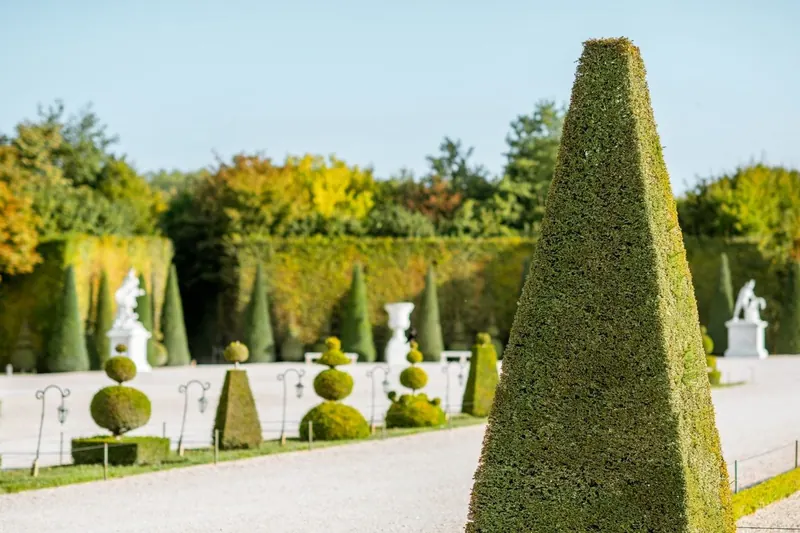
The English Garden around the Petit Trianon was designed to contrast deliberately with the rigid geometry of the famous formal gardens near the main palace.
Instead of long straight axes and symmetrical parterres, expect:
- winding paths
- irregular planting
- water features
- lawns
- small architectural follies
- carefully composed views that look accidental
The style was fashionable in late-18th-century Europe and reflected changing ideas about nature and landscape design. Walking through the English Garden is also the most atmospheric way to arrive at the Queen’s Hamlet.
Queen’s Theatre
Marie Antoinette loved theatre and private performances, and the small Queen’s Theatre was inaugurated in 1780.
From the outside it is fairly discreet. Inside, it was designed as a sophisticated private theatre where the Queen could watch performances and sometimes take part herself.
Access to particular interiors depends on the visit format and current opening arrangements, so don’t assume every part of the building comes with ordinary admission. Even from the outside, the theatre matters for understanding how Marie Antoinette used the Trianon Estate for private entertainment.
Queen’s Hamlet
The Queen’s Hamlet, or Hameau de la Reine, is one of the most unusual places at Versailles.
Marie Antoinette commissioned the architect Richard Mique to create it in the 1780s. The rustic-looking cottages were arranged around an artificial lake, producing an idealised rural landscape that feels strikingly unlike both the Palace of Versailles and the formal gardens.
What can you see at the Queen’s Hamlet?
The hamlet is a group of picturesque structures arranged around the water, including buildings associated with:
- the Queen’s House
- a mill
- dairy buildings
- farm activities
- entertaining guests
- agricultural functions
Some of these buildings were genuinely connected with the operation of a working farm.
A persistent myth has Marie Antoinette dressing as a shepherdess and playing at being a peasant here. The reality is more complicated. The hamlet was certainly an idealised aristocratic interpretation of rural life, but it also included a functioning agricultural component and was used for walks, small gatherings and the education of the royal children.
Is the Queen’s Hamlet worth the walk?
For most visitors who have already committed to exploring Trianon, yes.
It’s the part of the estate that feels furthest from the grandeur of the main palace — the lake, the cottages and the greenery create an entirely different atmosphere.
It also adds both walking time and sightseeing time. If you’re trying to do Versailles in a few hours, reaching the hamlet is what will make the day feel rushed.
If the Petit Trianon and the hamlet are the specific reason you’re going, the Marie Antoinette Petit Trianon & Estate tour skips the main palace entirely and rides the Petit Train back from the estate. It runs from $51 and is rated 4.7/5 — but only across 93 reviews, so read the recent ones before you commit.
How long do you need for the Trianon Estate?
Allow roughly 2 to 3 hours for a comfortable visit to the main Trianon sights.
A rough breakdown:
- Grand Trianon: 30–45 minutes
- Petit Trianon: 30–45 minutes
- gardens and walking between sites: 30–45 minutes
- Queen’s Hamlet: 45–60 minutes
If you enjoy gardens, photography or royal history, you could easily spend longer.
Can you see Trianon in one hour?
Technically you could see part of it, but an hour is too short for the full estate.
If you’re very limited on time, choose one of these:
- Grand Trianon + Petit Trianon, or
- Petit Trianon + Queen’s Hamlet
The second gives you the strongest Marie Antoinette–focused experience.
How far is Trianon from the Palace of Versailles?
Trianon is not next door to the main palace.
From the château, the walk through the estate takes roughly 30 minutes, depending on route and pace. That distance is easy to underestimate when you’re planning a Versailles visit — and it’s the single most common reason a Trianon plan collapses.
There are several ways to cover it:
- walk through the gardens and park
- take the little train
- use the estate’s small electric vehicles, subject to availability and operating conditions
If you want the Palace, Gardens and Trianon in one day, build the travel time between them into the schedule. Our guide to getting to Versailles from Paris covers the journey in from the city; this is the walking you do once you’re inside the gates.
There’s a third way to handle the distance: a guided golf-cart and bike tour that runs out to the Queen’s Hamlet and the fountains, which turns the crossing into part of the visit rather than the cost of it.
Best route through the Trianon Estate
For a first visit, a logical route is:
Grand Trianon → Grand Trianon Gardens → Petit Trianon → English Garden → Queen’s Hamlet
This roughly follows how the estate developed historically, and it avoids unnecessary backtracking.
1. Start at the Grand Trianon
Explore the palace interiors and gardens.
2. Continue to the Petit Trianon
Walk toward the smaller palace and see how dramatically the architecture changes between the reigns of Louis XIV and Louis XV.
3. Enter Marie Antoinette’s landscape
From the Petit Trianon, work through the French and English garden areas.
4. Continue to the Queen’s Hamlet
Finish at the most picturesque and informal part of the estate.
If you’re heading back toward the main palace afterwards, remember you still have a significant journey back across the Versailles grounds.
Trianon tickets: what type of ticket do you need?
Don’t assume every Palace of Versailles ticket automatically includes the full Trianon Estate. It doesn’t.
The official ticket options normally include the following.
Estate of Trianon ticket
This is for visitors who specifically want the Trianon area. It covers the principal Trianon sights:
- Grand Trianon
- Petit Trianon
- their gardens
- Queen’s Hamlet
It does not replace a Palace ticket if you also want to enter the main Palace of Versailles.
Versailles Passport
For the most complete one-day visit, the Passport is generally the simplest option, because it covers the wider Versailles estate including the Palace and Trianon.
It’s usually the better choice if your plan is:
Palace + Gardens + Grand Trianon + Petit Trianon + Queen’s Hamlet
The version sold on this site — the full-access Passport ticket — includes one-day access to the whole Versailles domain, Marie Antoinette’s estate and the Trianon among it, from $29. It’s rated 4.6/5 across 47,078 reviews. What it doesn’t include is a guide or a faster way through the security queue, which is the trade-off our Passport vs Palace ticket comparison works through in detail.
Ticket conditions, prices and seasonal garden access all change, so check the current inclusions for your date before booking.
What time does the Trianon Estate open?
The Trianon Estate generally opens later than the main Palace, with access beginning around midday. That single fact reshapes the whole day.
A good full-day sequence is therefore:
Morning: Palace of Versailles
Late morning / lunch: Gardens
Afternoon: Trianon Estate
It also stops you crossing the enormous estate more times than you need to.
Always check the calendar for your exact date, because opening days and seasonal closing times vary.
Can you visit Trianon without visiting the Palace?
Yes.
If you’ve already been to Versailles, or you’re mainly here for Marie Antoinette and the smaller royal residences, you can visit the Trianon Estate without repeating the main palace.
A Trianon-focused afternoon can be one of the most pleasant ways to experience Versailles, especially if you prefer gardens, architecture and less crowded spaces to grand state rooms.
Is Trianon included in the Paris Museum Pass?
Eligible Paris Museum Pass holders can access parts of the Versailles estate covered by the pass, but reservations and additional arrangements may still be required, and special garden events can affect access.
Don’t simply turn up assuming the pass works as an unrestricted all-in-one Versailles ticket. Check the current Versailles rules for pass holders before your visit and reserve any time slot you need.
If you’re weighing one up, the Paris Museum Pass (2, 4 or 6 days) is sold from $126 and rated 4.1/5 across 4,576 reviews — a noticeably lower score than the Versailles tours on this page, and the reservation requirement above is a large part of why.
Is Trianon less crowded than the Palace of Versailles?
Usually, yes.
Many day-trip visitors focus on the main château and the formal gardens. Because Trianon takes more time and more walking, fewer people carry on all the way to the Petit Trianon and the Queen’s Hamlet.
That doesn’t mean it’s empty, particularly in peak season, but the atmosphere can feel significantly calmer than the Hall of Mirrors and the main State Apartments. If the crowds inside the palace start to wear you down, Trianon is the change of pace. For the wider picture on timing, our crowd-avoidance guide has a month-by-month breakdown.
Palace of Versailles or Trianon: which should you prioritise?
If it’s your first visit to Versailles and time is short, prioritise the main Palace. The Hall of Mirrors, the State Apartments and the central château are the essential introduction — our guide to what to expect on a palace tour walks through that route room by room.
If you have most of a day, add Trianon.
The combination is far more rewarding, because the two areas show opposite sides of Versailles:
The Palace: power, ceremony and public monarchy
Trianon: privacy, retreat and personal royal life
And if you’ve already done the main Palace on a previous trip, several hours around Trianon is a very good reason to come back.
Is the Trianon Estate worth it?
For a full-day Versailles visit, yes.
Trianon is especially worth adding if any of these apply:
- you’re interested in Marie Antoinette
- you enjoy historic gardens
- you want to see more than the Hall of Mirrors
- you prefer quieter areas
- you’re interested in architecture
- you have at least half a day at Versailles
- this isn’t your first visit
Skip it if:
- you have only two or three hours in total
- you have limited mobility and don’t want to use internal transport
- your main priority is simply seeing the Palace of Versailles
- you’re visiting with young children who are already tired after the château and gardens
The biggest mistake isn’t that visitors skip Trianon. It’s that they try to squeeze the entire estate into an unrealistic schedule.
Suggested half-day Trianon itinerary
If Trianon is your main focus, this is a comfortable approach.
12:00 — Enter the Trianon Estate
Begin at the Grand Trianon.
12:00–12:45 — Grand Trianon
See the apartments, the Peristyle and the gardens.
12:45–13:15 — Walk to the Petit Trianon
Take your time through the landscaped grounds.
13:15–14:00 — Petit Trianon
Explore the palace and the surrounding garden.
14:00–15:00 — English Garden and Queen’s Hamlet
Follow the paths through Marie Antoinette’s landscape and around the lake.
After 15:00 — Return or keep exploring
If you still have the energy, spend more time in the gardens or the park before heading back toward the château or the town of Versailles.
Visiting Trianon as part of a full day at Versailles
A realistic full-day plan looks something like this:
09:00–11:00: Palace of Versailles
11:00–12:30: Formal gardens
12:30–13:15: Lunch and travel toward Trianon
13:15–16:00: Grand Trianon, Petit Trianon and Queen’s Hamlet
16:00 onward: Return through the park and gardens
Treat those times as a framework rather than a schedule. Versailles is large, and queues, walking time, seasonal events and your own interests will change the pace. Our Versailles gardens guide covers the middle stretch of that day — which fountains and groves are worth the detour, and when garden entry is charged.
Tips for visiting the Trianon Estate
Wear comfortable shoes
A Versailles day involves far more walking than most first-time visitors expect.
Don’t leave Trianon until the final 30 minutes of your visit
You won’t have enough time to enjoy it properly.
Check seasonal access
Garden events, fountains, temporary exhibitions and seasonal closing times all affect your route and your ticket requirements.
Carry water in warm weather
The estate is extensive and some stretches involve substantial outdoor walking.
Use internal transport strategically
The little train or the electric vehicles can save serious time if you’re tired, or travelling with children or older visitors.
Give the Queen’s Hamlet enough time
Don’t treat it as a single building. It’s a landscape, and it’s best explored on foot.
Frequently asked questions
What is the Trianon at Versailles?
The Trianon Estate is a more private section of the Versailles grounds containing the Grand Trianon, the Petit Trianon, their gardens and the Queen’s Hamlet. French monarchs used it as a retreat from the formal life of the main palace.
Is the Petit Trianon the same as Marie Antoinette’s house?
The Petit Trianon was built during the reign of Louis XV, not for Marie Antoinette. Louis XVI gave it to her in 1774, and it became closely associated with her afterwards.
What is the difference between the Grand Trianon and the Petit Trianon?
The Grand Trianon was built for Louis XIV in 1687 and is known for its pink marble architecture and formal gardens. The smaller Petit Trianon was completed in 1768 for Louis XV and later became Marie Antoinette’s private retreat.
Is the Queen’s Hamlet part of the Petit Trianon?
The Queen’s Hamlet forms part of the wider Trianon Estate and is closely connected with Marie Antoinette’s development of the grounds around the Petit Trianon.
How long does it take to visit the Grand Trianon and Petit Trianon?
Allow at least 1.5 hours for both palaces without the Queen’s Hamlet. For the full Trianon Estate, 2–3 hours is more realistic.
Can you walk from Versailles Palace to the Petit Trianon?
Yes. Expect roughly a 30-minute walk from the Palace area, depending on your route and pace.
Can you visit Trianon separately?
Yes. A dedicated Estate of Trianon ticket is available for visitors who want to explore Trianon without entering the main palace.
Does the Versailles Passport include Trianon?
The Versailles Passport is designed to give access to the wider estate and normally includes the Grand Trianon, the Petit Trianon and the Queen’s Hamlet. Always check the current inclusions for your date when booking.
What is the best order for visiting Trianon?
A practical first-time route is Grand Trianon → Petit Trianon → English Garden → Queen’s Hamlet.
Is the Trianon Estate good for a second visit to Versailles?
Yes. If you’ve already seen the main Palace, an afternoon around the Trianon Estate gives you a quieter and very different side of Versailles.
Final thoughts
The Trianon Estate is where Versailles stops being a symbol of monarchy and becomes a collection of places where individual members of the royal family actually tried to live.
The Grand Trianon shows Louis XIV seeking privacy without giving up royal elegance. The Petit Trianon reveals the more restrained architectural taste of the following reign. And the gardens, the theatre and the Queen’s Hamlet show how Marie Antoinette turned the estate into a retreat from the rigid life of the court.
If you have only a few hours at Versailles, focus on the main palace. But if you can give the estate a full day, Trianon is one of the best additions you can make.
Rather than rushing it, plan on at least two hours here — and treat the journey beyond the main château as part of the experience.
Walk the Hall of Mirrors — Without the Line
Join 11,869+ guests who rated this Versailles palace tour 4.7/5. Skip-the-line entry, a 90-minute licensed guide, and full gardens access — with free cancellation.
Check Availability & Book