Versailles Gardens Guide: What to See, Tickets, Fountains & Best Route
What to see in the Gardens of Versailles, when garden entry is free and when it's charged, how the fountain shows work, and the best route for a first visit.
The Gardens of Versailles are not simply the landscaped space behind the palace. They are one of the main attractions of Versailles in their own right.
Designed principally under Louis XIV by the landscape architect André Le Nôtre, they combine vast geometric perspectives, formal parterres, sculpture, fountains, hidden groves and long tree-lined avenues running away from the château.
They are also far larger than they first look. From the Palace terrace you can see the central axis running toward the Grand Canal, but much of the most interesting garden is concealed behind hedges and walls. Some of the famous groves can’t be seen from the main paths at all.
This guide covers what to see in the Versailles Gardens, how much time to allow, whether you need a separate ticket, how the Musical Fountains Show and Musical Gardens differ, and the best route for a first visit.
One thing to settle before you book: garden admission depends on the date, and the ticket that covers every version of the day is the full-access Passport. It bundles one-day access to the whole domain — gardens, Trianon and Marie Antoinette’s estate — plus Musical Gardens or Fountain Show access during the show season, from $29. Guests rate it 4.6/5 across 47,078 reviews. Prices and seasonal conditions change, so check the calendar for your exact date.
Are the Versailles Gardens worth visiting?
Yes.
If it’s your first visit to the Palace of Versailles, treat the gardens as part of the experience rather than an optional extra.
The palace shows how the French monarchy presented itself indoors. The gardens continue exactly the same argument outdoors, and everything in them was designed to impress:
- enormous perspectives
- perfect symmetry
- monumental fountains
- carefully framed views
- sculpture drawn from classical mythology
- hidden groves used for entertainment
- controlled transitions between architecture, water and landscape
They’re also a welcome contrast after the crowded interiors of the Palace.
You don’t need to see every corner to enjoy them — even a 60- to 90-minute walk covers the main highlights. But if you want to explore the groves, the fountains and the Grand Canal properly, allow closer to two hours.
Who designed the Gardens of Versailles?
The gardens are most closely associated with André Le Nôtre, the great French landscape architect of the 17th century.
Work began in the early years of Louis XIV’s transformation of Versailles and continued for decades alongside the expansion of the palace.
Le Nôtre developed the gardens in the formal French style, using:
- symmetry
- long visual axes
- geometric planting
- terraces
- clipped hedges
- ornamental pools
- fountains
- carefully controlled perspectives
The landscape was designed to look ordered and effortless. Creating it required enormous engineering and manpower: thousands of trees were brought to Versailles, earth was moved on a huge scale, and complex hydraulic systems had to be developed to supply the fountains.
The result became one of the most influential formal gardens in Europe.
How big are the Gardens of Versailles?
The first thing to understand is that the Gardens are only one part of the wider Versailles estate.
Visitors often say “Versailles Gardens” to mean everything outside the palace, but officially the estate contains several different areas:
- The Palace
- The Gardens
- The Park
- The Trianon Estate
The formal Gardens run from the Palace toward the Grand Canal and hold the famous parterres, fountains and groves. Beyond them lies the much larger Park, including the Grand Canal and the broader open landscape. Further out again you reach the Grand Trianon, Petit Trianon and Queen’s Hamlet — covered in our Trianon Estate guide.
The distinction matters, because opening arrangements and ticket rules differ between the Gardens and the Park.
Other experiences you might enjoy
The gardens are one section of a very large estate, and most visitors build a day around them. The standard combinations are the Palace of Versailles and the Hall of Mirrors in the morning, the Latona and Apollo fountains and the Grand Canal in the afternoon, and — if there’s time — the Grand Trianon, the Petit Trianon and Marie Antoinette’s Queen’s Hamlet beyond them. Bike, e-bike and golf-cart tours exist precisely because the distances are so large, and day trips from Paris frequently pair Versailles with Giverny and Monet’s garden. Here’s what’s bookable right now:
What to see in the Versailles Gardens
There’s no need to visit every fountain and grove on a first trip. The most rewarding route combines the major viewpoints with a few of the hidden spaces. These are the highlights to prioritise.
1. Water Parterre
The Water Parterre sits immediately behind the Palace and is one of the best places to begin.
Two large rectangular pools reflect the Palace façade and the sky, producing one of the most elegant views at Versailles. This elevated terrace also gives you your first clear look down the central axis.
From here you can see:
- Latona’s Fountain
- the Royal Way
- Apollo’s Fountain
- the distant Grand Canal
Take a few minutes before you descend. The design makes far more sense once you’ve seen the whole central perspective from above.
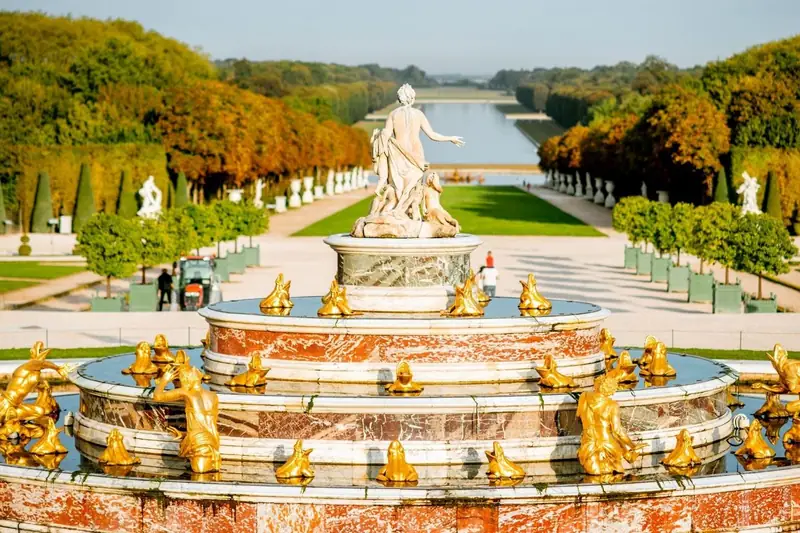
2. Latona’s Fountain
Directly below the Palace terraces is Latona’s Fountain, one of the most important fountains at Versailles.
It illustrates the myth of Latona, mother of Apollo and Diana. According to the story, peasants refused her water and mocked her; as punishment, Jupiter turned them into frogs and lizards. The fountain’s sculptural decoration shows that transformation.
More usefully for visitors, Latona’s Fountain forms the visual link between the Palace and the central axis running toward Apollo’s Fountain and the Grand Canal. It’s one of the essential photo stops in the gardens.
3. Royal Way
From Latona’s Fountain, continue along the Royal Way, sometimes called the Green Carpet.
This broad grassy avenue is one of the defining perspectives of Versailles. Large classical statues line the route while dense hedges conceal groves on both sides — one of the cleverest features of the design. From the main axis everything looks perfectly ordered, but smaller garden rooms sit hidden just metres away.
Don’t simply walk straight toward Apollo’s Fountain. Leave the main route occasionally and explore at least a few groves.
4. Apollo’s Fountain
At the far end of the Royal Way is Apollo’s Fountain.
Apollo, the sun god, carried powerful symbolic weight for Louis XIV, the “Sun King”. The sculptural group shows Apollo rising from the water in his chariot, accompanied by horses and attendants.
It’s one of the most recognisable fountains at Versailles and another essential stop on the central route. From here the landscape opens toward the Grand Canal.
5. The Grand Canal
The Grand Canal is the enormous cross-shaped body of water beyond the formal gardens.
Technically it belongs to the wider Park rather than the ornamental Gardens, but most visitors carry on toward it anyway. It dramatically extends the perspective from the Palace, was used historically for boating and royal entertainment, and its surrounding paths are among the most relaxed parts of the estate.
If you have several hours at Versailles, walking to the canal is worthwhile. If you don’t, you can see it clearly from the formal gardens without walking all the way down.
6. Orangery
The Orangery is one of the most impressive architectural features of the gardens.
It sits below the south side of the Palace and was designed by Jules Hardouin-Mansart. The formal Orangery parterre is surrounded by monumental architecture and holds citrus trees that can be moved indoors during colder months.
From the Palace terrace above, the geometric pattern is particularly striking. If the area is accessible on your visit, add it to your route.
7. The Groves
The groves, or bosquets, are among the most distinctive features of Versailles. Think of them as outdoor rooms enclosed by hedges and trees.
Many were designed for court entertainment and contained:
- fountains
- sculpture
- decorative architecture
- water features
- performance spaces
- carefully controlled entrances and sightlines
Some groves are usually closed or less accessible outside the Musical Gardens and Musical Fountains periods. If you’re visiting on a day when they’re open, take the opportunity.
8. Ballroom Grove
The Ballroom Grove, also known as the Rocaille Grove, is one of the most beautiful hidden areas.
Its distinctive feature is a stepped cascade decorated with shells and stonework. The grove was designed as an outdoor ballroom, with music and dancing forming part of court entertainment.
Because it’s enclosed by greenery, entering it feels completely unlike walking the enormous central avenues.
9. Colonnade Grove
The Colonnade Grove is another particularly memorable garden room.
A circular colonnade encloses an open space with sculpture at its centre. Its architecture contrasts with the surrounding greenery and shows exactly how the groves were designed as theatrical surprises.
If you only have time for a few groves, this is a strong choice.
10. Enceladus Grove
The Enceladus Grove contains a dramatic fountain showing the giant Enceladus being crushed beneath rocks, with water shooting from his mouth as part of the composition.
Like many Versailles fountains, the scene comes from classical mythology and carries themes of power, order and punishment. It’s one of the more dramatic sculptural fountains in the gardens.
11. Three Fountains Grove
The Three Fountains Grove is built around a sequence of water displays arranged on different levels.
It’s especially attractive during fountain-show periods, when the hydraulic design becomes part of the experience. Its more intimate scale makes a good contrast with the huge vistas of the main axis.
12. Neptune Fountain
The Neptune Fountain is one of the largest and most complex fountain compositions at Versailles, located toward the northern side of the gardens.
The enormous basin holds numerous sculptural and water effects and is particularly impressive when the fountains are operating. If you’re attending the Musical Fountains Show, include it in your route.
13. Dragon Fountain
Near the Neptune area, the Dragon Fountain depicts the dragon Python surrounded by dolphins and other creatures.
Its powerful central jet historically demonstrated the technical ambition of the Versailles waterworks. The fountain forms part of a sequence of mythological references connected with Apollo.
The Four Seasons Fountains
At major garden crossroads you’ll also meet four fountains dedicated to the seasons:
- Flora Fountain — spring
- Ceres Fountain — summer
- Bacchus Fountain — autumn
- Saturn Fountain — winter
They were created in the 1670s and help structure the garden’s network of alleys. You don’t need to seek out all four on a short visit, but they’re useful landmarks when you’re exploring away from the central axis.
Versailles Gardens vs Park: what is the difference?
This is one of the most common sources of confusion.
Versailles Gardens
The formal gardens immediately beyond the Palace, including:
- parterres
- fountains
- sculptures
- formal avenues
- groves
Admission can be charged on Musical Fountains Show and Musical Gardens days.
Versailles Park
The Park lies beyond the formal Gardens and takes in the wider landscape around the Grand Canal. The atmosphere is much more open and informal.
The Park is generally free to enter, though access rules occasionally vary because of events or weather.
If your goal is the famous fountains and André Le Nôtre’s formal design, you want the Gardens, not simply the Park.
Are the Versailles Gardens free?
Sometimes.
One of the most important ticket rules at Versailles is that garden admission depends on the date.
On ordinary days, with no special garden programme running, access to the Gardens is generally free. Admission is charged on days when the Musical Fountains Show or Musical Gardens is taking place.
This is why two people visiting Versailles a few days apart can have completely different experiences and ticket requirements. Always check the official calendar for your exact date.
Do you need a separate ticket for the Versailles Gardens?
It depends on your main ticket and on the date.
If you buy a Versailles Passport, garden access is included — including during the Musical Fountains Show or Musical Gardens, within the conditions of the ticket. If you only want the gardens on a paid garden-event day, garden-only tickets are also available.
A standard Palace ticket should not be treated as equivalent to a full-estate Passport. Our Passport vs Palace ticket comparison sets out where the line falls.
Before booking, decide what you actually want to see:
- Palace only
- Palace + Gardens
- Gardens only
- Palace + Gardens + Trianon
For a full-day first visit, the Passport is generally the simplest option. If you’d rather have a guide walk you through the palace and then keep gardens access afterwards, the skip-the-line guided palace and gardens tour featured on this site covers both — from $79, rated 4.7/5 across 11,869 reviews. There’s also a Gardens of Versailles walking tour with palace entry that puts a guide on the groves themselves rather than the state rooms, from $74 and rated 4.5/5 across 257 reviews.
What is the Musical Fountains Show?
The Musical Fountains Show is a seasonal programme in which selected fountains operate while baroque music plays across parts of the gardens. It’s the closest a modern visitor gets to experiencing the gardens as the choreographed royal spectacle they were designed to be.
Points worth knowing:
- not every fountain necessarily runs continuously
- different fountains may operate to a schedule
- several groves are opened for the occasion
- garden admission is charged
- fountain operations can be affected by technical or water-management conditions
If fountains are a major reason for your visit, choose a Musical Fountains Show day.
What are the Musical Gardens?
The Musical Gardens are a different thing from the Musical Fountains Show.
On Musical Gardens days, you can explore the formal gardens and specially opened groves accompanied by music, but the fountains don’t follow the same full water-display programme.
It can still be a very good time to visit, because some garden areas that are otherwise hard to reach are open. If seeing fountains actually running is the priority, though, make sure you’ve picked a Musical Fountains Show rather than simply a Musical Gardens day.
When do the fountain shows run?
The programme changes from year to year.
In 2026, the Palace of Versailles is running Musical Gardens and Musical Fountains programming from spring into autumn.
Because exact days differ by month, and special evening events can affect closing times, check the official Versailles calendar for your date rather than relying on a generic weekly pattern. This matters most if you’re building your entire visit around the fountains.
What time do the Versailles Gardens open?
Opening hours vary by season.
The Gardens generally open early in the morning and stay open later than the Palace during the warmer months. In high season they can remain open into the evening, although some dates have early garden closures because of preparations for the Night Fountains Show. In winter, closing time is earlier.
Always check your specific date, especially if you plan to visit the Gardens after touring the Palace in the afternoon.
How long do you need in the Versailles Gardens?
For most first-time visitors:
- 1 hour: essential highlights only
- 1.5–2 hours: a good first visit
- 2–3 hours: gardens, several groves and the Grand Canal
- half day: relaxed exploration, photography and the fountain programme
The official Versailles visitor information recommends allowing around 1.5 to 2 hours for the Gardens. That’s a sensible minimum if they’re an important part of your visit.
Can you visit the Palace and Gardens in half a day?
Yes, but you’ll need to prioritise.
A realistic half-day itinerary:
09:00–10:45 — Palace
10:45–12:15 — Gardens
12:15 onward — leave, or continue toward the Grand Canal
That gives you the central garden route but not a thorough exploration of the groves, the Park and Trianon. If you also want the Grand Trianon, Petit Trianon and Queen’s Hamlet, plan a full day.
Best route through the Versailles Gardens
For a first visit, this route gives you the major landmarks without excessive backtracking.
1. Start at the Water Parterre
Take in the full central perspective from the Palace.
2. Descend to Latona’s Fountain
Walk down the terraces and see the fountain up close.
3. Explore one or two groves
Choose groves near the central axis rather than trying to see every one.
4. Follow the Royal Way
Continue toward Apollo’s Fountain.
5. Stop at Apollo’s Fountain
This is the key point between the formal Gardens and the Grand Canal.
6. Decide whether to continue to the Grand Canal
If time is short, turn back toward the Palace on a different path. If you have more, walk down toward the canal.
7. Add the Neptune Fountain area
On the way back, explore the northern side of the gardens if time allows.
This route takes roughly 90 minutes to two hours, depending on how many groves are open and how often you stop.
Best Versailles garden route on a fountain show day
If you came specifically for the fountains, your strategy should be different. Don’t simply follow the central axis.
Check the day’s official fountain timetable and build your route around the periods when the larger fountains are operating. Prioritise:
- Latona’s Fountain
- Apollo’s Fountain
- Neptune Fountain
- Dragon Fountain
- open groves with water features
Arrive with the official map or the Versailles app already downloaded. The gardens are large enough that crossing from one side to the other for a short fountain sequence can waste a lot of time.
Best time of day to visit the gardens
For most visitors there are three good options.
Early morning
Best for:
- quieter paths
- photography
- cooler temperatures in summer
- seeing the gardens before the Palace crowds spill outside
Around lunchtime
A useful option if you tour the Palace first. Crowds spread out significantly once visitors reach the huge garden area.
Late afternoon
The gardens can feel particularly pleasant later in the day, once many organised groups have left. Check closing times carefully, though — on Night Fountains dates the Gardens can close earlier for preparations.
Should you visit the gardens before or after the palace?
For most first-time visitors, Palace first, Gardens second works best. The reasons:
- Palace entry uses a timed slot
- indoor queues are easier to manage earlier
- the Gardens are more flexible
- you can stay outside as long as your schedule allows
If you have a later Palace entry, though, exploring the Gardens first is completely reasonable. Just leave enough time to get back to the Palace entrance before your reservation. Our guide to what to expect on a palace tour covers how the indoor half of the day actually runs.
Are the fountains always running?
No. This surprises a lot of first-time visitors.
The fountains are not left running all day, every day. Operating a hydraulic system of that age and scale takes careful management, and fountain displays are generally tied to specific seasonal programmes.
If you visit on an ordinary day, you may well see the fountains without water effects. If the full spectacle matters to you, book your visit for a Musical Fountains Show date.
Can you visit the gardens in winter?
Yes.
The Versailles Gardens stay impressive in winter, because their structure rests on geometry and perspective rather than flowers.
Advantages:
- fewer visitors
- dramatic long views
- easier photography
- no summer heat
- usually free garden access
The experience is different, though. In the low season:
- fountains are generally not operating
- some groves may be closed
- statues can be covered for conservation
- vegetation is less lush
- daylight hours are shorter
If your priority is the full fountain-and-garden spectacle, visit in the warmer months. If it’s architecture, landscape design and lower crowds, winter is still rewarding — and our crowd-avoidance guide breaks the year down month by month.
Can you take the little train through the gardens?
The estate runs a little train connecting the major areas of Versailles.
It’s useful if:
- you’re travelling with children
- someone in your group has difficulty walking long distances
- you want to reach Trianon without walking the whole route
- you’re tired after touring the Palace
It’s not a replacement for exploring the formal Gardens on foot, though. Many of the best garden details and groves need walking.
Can you rent a golf cart at Versailles?
Small electric vehicles are available for hire within the estate, subject to current rules, availability and weather.
They help with the enormous distances between the Palace area, the Grand Canal and Trianon. Again, they’re more useful for transport across the estate than for exploring the formal groves.
If you’d rather have the route planned for you, the guided golf-cart and bike tour covers the Queen’s Hamlet and the fountains on a set circuit, with the vehicle and the guide included.
Are bikes allowed in the Versailles Gardens?
Bicycles are not permitted inside the formal Gardens. Cycling is possible in designated areas of the wider Park.
That’s another reason understanding the difference between the Gardens and the Park is useful — and why the bike and golf-cart tours sold for Versailles ride the Park and the estate roads out to Trianon rather than the parterres you came to see.
Is there food in the Versailles Gardens?
There are several cafés, restaurants and refreshment options around the wider estate, though opening arrangements vary seasonally.
If you’re spending a full day at Versailles, plan your meal rather than waiting until you’re exhausted. One practical sequence:
Palace → Gardens → lunch near the Grand Canal → Trianon
That breaks up the walking and creates a natural route through the estate.
Can you bring food into the Versailles Gardens?
Picnicking is not permitted everywhere inside the formal Gardens. If you want a picnic, the wider Park is generally the appropriate area.
Follow the current signs and visitor rules — restrictions change, and certain lawns and landscaped areas have to stay protected.
Are the Versailles Gardens accessible?
Large parts of the estate can be visited by people with reduced mobility, but don’t underestimate the distances.
Paths are a mixture of:
- paved areas
- gravel
- slopes
- long level avenues
Internal transport options make the visit easier. If accessibility matters for your group, check current Versailles accessibility information before you arrive and plan a shorter route rather than trying to cover the whole estate.
Visiting the Versailles Gardens with children
The Gardens are often easier with children than the Palace. There’s more space, fewer confined rooms and more opportunity to take breaks.
Children tend to enjoy:
- fountains
- hidden groves
- the Grand Canal
- the little train
- wide paths
- exploring different garden “rooms”
The main challenge is distance. Don’t plan Palace + full Gardens + Trianon + Queen’s Hamlet with young children unless your family is comfortable with a very long day.
What should you wear?
Comfortable footwear matters far more than formal clothing. Expect considerable walking over gravel and uneven surfaces.
In summer:
- bring water
- use sun protection
- wear a hat if needed
In cooler months:
- expect exposed areas
- bring a rain layer
- wear shoes suitable for damp gravel paths
Versailles is not a compact urban museum. Treat the Gardens more like a large historic park.
Versailles gardens photography tips
For the best wide garden photographs:
Water Parterre
Best for Palace reflections and the main perspective.
Latona’s Fountain
Excellent looking both toward the Palace and down the Royal Way.
Apollo’s Fountain
One of the most recognisable compositions.
Orangery viewpoint
Strong geometric patterns, particularly from above.
Groves
Best for more intimate photographs without the huge open vistas.
Early morning and late afternoon usually give softer light than midday.
Palace of Versailles gardens: common mistakes
Trying to see everything
The Gardens hold too many features for most visitors to inspect individually. Choose a route and a handful of highlights.
Assuming the fountains run every day
They don’t. Check the fountain programme before booking.
Assuming the gardens are always free
Admission is charged during Musical Fountains and Musical Gardens programmes.
Forgetting the walking distances
The Grand Canal looks close from the Palace terrace. Versailles’ scale is deceptive.
Planning Trianon as a quick add-on
The Trianon Estate lies well beyond the main Palace and the formal Gardens. Allow several additional hours if you want to include it properly.
Not checking for early closures
Night Fountain events and other programmes can change normal garden closing times.
Suggested 90-minute Versailles gardens itinerary
If your schedule is tight, use this route:
0:00–0:10 — Water Parterre and overview
0:10–0:25 — Latona’s Fountain
0:25–0:45 — one or two nearby groves
0:45–1:00 — Royal Way
1:00–1:15 — Apollo’s Fountain
1:15–1:30 — return via a different path
That gives you a genuine experience of the gardens without committing most of the day.
Suggested 2-hour Versailles gardens itinerary
For a more complete first visit:
0:00–0:15 — Water Parterre
0:15–0:30 — Latona’s Fountain
0:30–1:00 — several groves
1:00–1:15 — Royal Way
1:15–1:30 — Apollo’s Fountain
1:30–1:50 — Grand Canal viewpoint, or a short walk toward it
1:50–2:00 — begin the return toward the Palace or your next destination
On fountain-show days, adjust the route according to the day’s water schedule.
Frequently asked questions
Are the Gardens of Versailles free?
The Gardens are generally free on days without the Musical Fountains Show or Musical Gardens. On event days, paid admission applies.
Do Palace of Versailles tickets include the gardens?
It depends on the ticket type and the date. The Versailles Passport includes access to the Gardens, including paid garden-event days under its conditions. Check the exact inclusions before booking.
How long should I spend in the Versailles Gardens?
Allow 1.5 to 2 hours for a good first visit. One hour is enough for the essential highlights, while two to three hours gives you time for groves and the Grand Canal.
Are the Versailles fountains always on?
No. Fountain operation is linked mainly to the seasonal Musical Fountains Show and to specific schedules.
What is the difference between Musical Gardens and Musical Fountains?
Musical Gardens gives access to the gardens and specially opened groves with music. The Musical Fountains Show also includes scheduled fountain water displays.
Can I visit the gardens without entering the palace?
Yes. You can visit the Gardens separately. On paid event days you need the appropriate garden ticket.
What is the best part of the Versailles Gardens?
For a first visit, prioritise the Water Parterre, Latona’s Fountain, the Royal Way, Apollo’s Fountain and at least one or two groves.
Is the Grand Canal inside the Versailles Gardens?
The Grand Canal lies in the wider Park beyond the formal Gardens, although it forms part of the same central visual axis.
Can I walk from the palace to the Grand Canal?
Yes. The route is straightforward, but allow plenty of time — the estate is much larger than it appears from the Palace terrace.
Can I walk from the gardens to Trianon?
Yes. Trianon can be reached on foot through the estate, but expect substantial additional walking.
Is there a separate Versailles Gardens entrance?
There are several access points to the Gardens, including from the Palace side and gates connecting with other parts of the estate. Which entrances are open varies by season and event.
What is the best time to see the Versailles Gardens?
Spring through early autumn gives the fullest garden experience, especially on fountain-show dates. Early morning and late afternoon are usually best for lighter crowds and photography.
Final thoughts
The Versailles Gardens are one of the clearest expressions of Louis XIV’s vision for Versailles.
The Palace demonstrated royal power through architecture, ceremony and interior decoration. The Gardens extended the same message into the landscape itself. Every major axis, fountain and hidden grove was designed to control what visitors saw and how they moved through the estate.
For a first visit, you don’t need to explore every path. Start with the central perspective, see Latona’s and Apollo’s fountains, walk through at least a few groves, and decide whether you have time to continue toward the Grand Canal.
Allow around two hours if you can.
And if the fountains are one of the main reasons you want to come, check the Musical Fountains Show calendar before choosing your date. The Gardens are impressive at any time of year, but seeing the fountains, groves and music working together gives you a much better sense of the spectacle Versailles was built to create.
Walk the Hall of Mirrors — Without the Line
Join 11,869+ guests who rated this Versailles palace tour 4.7/5. Skip-the-line entry, a 90-minute licensed guide, and full gardens access — with free cancellation.
Check Availability & Book