Versailles Park, Grand Canal and Orangerie: What to See Beyond the Palace
The free Park of Versailles, the 1,670-meter Grand Canal, the Orangerie and the Lake of the Swiss Guard: access rules, bikes, boats, picnics, hours and the best walking route.
The Park of Versailles is free, open every day and far bigger than the formal Gardens behind the Palace. Past Apollo’s Fountain, André Le Nôtre’s clipped geometry gives way to long avenues, lawns, woodland, the Grand Canal, the Lake of the Swiss Guard and the paths that lead on to the Trianon Estate. Closer to the Palace, the Orangerie sits below the South Parterre, with about 1,055 containers of orange trees, palms, oleanders and pomegranates set out across its parterre in summer.
Head into the Park if you want a quieter side of Versailles, free outdoor access, a picnic, a bike ride or a rowing boat, a break from the Palace crowds, or a scenic route toward Trianon. This guide covers the difference between the Gardens and the Park of Versailles, what to see around the Grand Canal and the Orangerie, which areas are free, how much time to allow and a route that avoids backtracking.
The Park costs nothing, but covering it on foot takes stamina. If you would rather ride, the From Paris: Skip-the-Line Palace of Versailles Bike Tour pairs a guided Palace visit with a bike loop through the gardens, the Trianon and Marie Antoinette’s hamlet, plus a market picnic beside the Grand Canal, from $166 and rated 4.9/5 from more than 500 reviews. Check the dates left for your trip here.
Versailles Gardens vs Park: What Is the Difference?
This distinction affects what you pay. Many visitors call everything outside the Palace “the Versailles Gardens”, but the château divides the estate into four areas with different access rules:
| Area | What it holds | Access |
|---|---|---|
| Palace | State Apartments, Hall of Mirrors, royal apartments | Passport ticket, closed Mondays |
| Gardens | Fountains, groves, parterres behind the Palace | Free most days; ticketed on Musical Gardens and Musical Fountains days |
| Park | Grand Canal, avenues, lawns, woodland, Lake of the Swiss Guard | Free every day |
| Estate of Trianon | Grand Trianon, Petit Trianon, Queen’s Hamlet | Passport or Trianon ticket, closed Mondays |
Palace entry needs the Passport, which you can also book through a marketplace as the Paris: Versailles Palace and Gardens Full Access Ticket, from $29 and rated 4.6/5 from more than 48,000 reviews. The formal Gardens and the Park are not the same place. You can walk from one into the other, and on show days the Gardens charge admission while the Park beyond stays free. Our Versailles gardens guide covers the fountains and groves in detail; this page picks up where the groves end.
Other experiences you might enjoy
Beyond the Park you can cycle the Gardens of Versailles, tour the Grand Canal and the Queen’s Hamlet by golf cart, or pair Versailles with Paris or Monet’s Giverny.
The Gardens
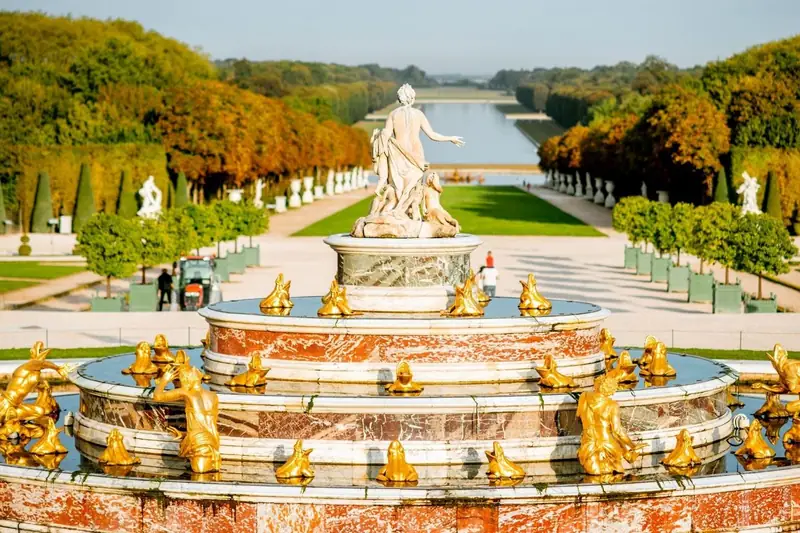
The formal Gardens of Versailles are the landscaped area immediately behind the Palace: the Water Parterre, Latona’s Fountain, the Royal Way, Apollo’s Fountain, and the formal parterres, statues, fountains and groves around them.
This is the tightly controlled landscape that André Le Nôtre created for Louis XIV. During the Musical Gardens and Musical Fountains programs, access to this area is ticketed; the fountain show guide lists the dates and prices.
The Park
The Park begins where the formal Gardens end. It is much larger and more open, and it includes:
- the Grand Canal
- broad avenues
- lawns
- wooded areas
- agricultural land
- routes toward Trianon
- the Lake of the Swiss Guard
The Park covers roughly 800 hectares and keeps much of the historic perimeter of the Versailles estate. For visitors, the key fact is simple: entry to the Park is free. You can spend a morning here without buying a Palace ticket at all.
Is Versailles Park Free?
Yes. The château opens the Park free of charge every day of the year, except during exceptional closures for severe weather or safety reasons.
You can walk around the Grand Canal, the Park avenues, the Royal Star (Étoile Royale) and the wider open landscape without a ticket. You do not need a Versailles Passport just to walk in the Park.
Is the Grand Canal Free to Visit?
Yes. The Grand Canal lies within the Park, so you can reach it without paying for the Palace.
Your route matters, though. If you enter from the Palace side and cross the formal Gardens on a day when garden admission is charged, you need a garden ticket for that stretch. If you come in through one of the Park’s own public gates, you reach the Grand Canal directly and pay nothing.
That route helps repeat visitors, local walkers, cyclists, picnickers and anyone who only wants to see the wider estate.
What Is the Grand Canal at Versailles?
The Grand Canal is the huge cross-shaped stretch of water that runs west from the formal Gardens. It closes the famous east-west Grande Perspective. From the Palace, the central view runs:
Water Parterre → Latona’s Fountain → Royal Way → Apollo’s Fountain → Grand Canal
Seen from the terrace, the canal makes the landscape look as though it carries on to the horizon.
How Long Is the Grand Canal?
The main arm of the Grand Canal is 1,670 meters long, according to the château. Digging took 11 years, from 1668 to 1679.
Versailles is bigger than it looks. From the Palace terrace the canal looks close; once you start walking, you find out how big the estate is.
Why Was the Grand Canal Built?
The canal had both a visual and a practical job. It extended the central perspective of the Gardens and reflected the sky, which gives the western end of the landscape its light, open feel.
Under Louis XIV it was also used for:
- boating
- royal entertainment
- festivals
- water spectacles
- transport within parts of the estate
Its banks became the setting for major court celebrations.
Louis XIV’s Boats on the Grand Canal
Louis XIV kept a remarkable fleet at Versailles. From 1669 he sailed rowing boats on the canal, and in summer it held the king’s collection of vessels, from rowing boats and pleasure craft to ceremonial vessels and gondolas.
In 1674, the Republic of Venice sent Louis XIV two gondolas and four gondoliers. The gondoliers were housed near the canal, in an area that became known as Little Venice. The name survives today.
Little Venice at Versailles
The area at the head of the Grand Canal is still called Petite Venise, or Little Venice. It was tied to the boats and gondoliers used for royal entertainment, and today it is a handy landmark because several visitor facilities sit close by.
Around the canal you can stop for lunch, rent a boat, take a break, start a route toward Trianon or simply enjoy the Park away from the Palace crowds.
Can You Rent a Boat on the Grand Canal?
Yes, in season. Small rowing boats are rented by the canal and give you Versailles from the water, which suits couples, families, repeat visitors and warm-weather days.
Boat hire is sold on site by the concession beside the canal, not through the château’s tickets, and it is not included in any Versailles admission. Opening dates and prices change by season, and hire usually stops in the colder months, so check before you plan a day around it.
Did the Grand Canal Freeze in Winter?
Yes. The château records that in cold winters the frozen canal was used for skating and sledding.
That detail shows the Park was a royal landscape in use all year, and more than a backdrop to the Palace. Its spaces hosted walks, hunting, boating, performances, festivals and winter games.
The Grand Canal and Royal Festivals
The canal set the stage for some of Louis XIV’s largest entertainments. During the royal festivities of 1674, the canal was lit up at night, and water, fire, music and architecture were combined in the kind of spectacle Versailles became known for.
The modern Night Fountains Show carries on that tradition in a very different form.
Can You Walk Around the Grand Canal?
Yes. The banks are popular for walking, and you do not need to circle the whole cross-shaped canal to enjoy it. A shorter visit can be:
- Apollo’s Fountain
- a walk down to the head of the canal
- a stroll along one bank
- back toward the Gardens, or on to Trianon
For a longer outing, the Park’s broad avenues take you much farther.
How Long Does It Take to Walk to the Grand Canal?
From the Palace, allow roughly 20–30 minutes, depending on your pace, your route, how often you stop and whether you explore groves on the way.
The walk out is downhill and the walk back is uphill. People underestimate that climb: after several hours in the Palace and Gardens, the return can feel much longer than the way down.
Can You Cycle in Versailles Park?
Yes. Cycling is allowed in the Park, one of the main differences from the formal Gardens, where bikes are not permitted.
A bike lets you cover the Grand Canal, the Park avenues, the routes toward Trianon and the wider estate without walking for hours. Bikes are rented seasonally inside the estate, near the Grand Canal. If you want to reserve ahead, the Versailles Bike Rentals listing rents bikes from $11, rated 4.6/5 from only 28 reviews, so treat that score as an early read. For a guided ride with tickets included, the Versailles: Palace and Garden Bike Tour with Tickets adds a picnic along the Grand Canal and the Trianon palaces, from $112 and rated 4.7/5 from about 300 reviews.
Are Bikes Allowed in the Versailles Gardens?
No. Bicycles are not permitted in the formal Gardens. Stick to the routes where cycling is allowed in the Park, and do not read a Park cycling map as permission to ride through the fountain groves near the Palace.
Can You Picnic in Versailles Park?
Yes, and the Park is the best place at Versailles to do it. The formal Gardens restrict picnics; the Park does not.
Popular spots are around the Grand Canal, on the lawns and across the wider Park. Bring a blanket and food for a relaxed break between the Palace and Trianon, follow the signs on the day and take your rubbish with you.
Where Is the Best Place for a Picnic?
For most visitors, near the Grand Canal is the easiest choice. You get open views, large lawns, food stalls and toilets nearby, paths on to Trianon and room to sit away from the Palace crowds.
It is also roughly halfway between the Palace and the Trianon Estate.
Food Near the Grand Canal
Several places to eat operate around the Grand Canal. The best known is La Flottille, a restaurant beside the canal, and seasonal takeaway kiosks open nearby in the warmer months.
That makes the canal a natural lunch stop on a full day. A practical order is:
Palace → Gardens → Grand Canal lunch → Trianon
You avoid walking back on yourself.
The Versailles Orangerie
The Orangerie is one of the great architectural pieces of Versailles. It sits below the South Parterre, close to the Palace, and its monumental form is the work of Jules Hardouin-Mansart.
The first orangery on the site was designed by Louis Le Vau in 1663. About twenty years later Hardouin-Mansart replaced it with a building twice the size, completed in the 1680s.
Why Did Versailles Need an Orangerie?
Citrus trees were luxury objects in northern European royal gardens. Orange trees in particular signaled wealth, the exotic, royal prestige and skilled horticulture.
The French winter would kill them outdoors, so the Orangerie gave Versailles somewhere to keep a large collection of:
- orange trees
- lemon trees
- palm trees
- oleanders
- pomegranate trees
- other exotic plants
Some of the trees are more than two centuries old.
How Big Is the Versailles Orangerie?
Big, even by Versailles standards. The central gallery is more than 150 meters long, under a vaulted ceiling about 13 meters high, with two side galleries.
Thick walls, double windows and a south-facing position keep the plants from freezing in winter.
How Many Orange Trees Are at Versailles?
The château counts about 1,055 containers in the collection. They spend the winter inside the Orangerie and are set out across the Orangerie parterre in summer.
The plants include orange trees, lemon trees, palms, pomegranates, oleanders and other species. The collection was one of the great horticultural status symbols of Louis XIV’s Versailles.
Did Courtiers Give Louis XIV Orange Trees?
Orange trees made prestigious gifts, and the royal collection grew through gifts, purchases and seizures. Many of the first trees came from Nicolas Fouquet’s estate at Vaux-le-Vicomte after his fall in 1661.
Louis XIV also had citrus plants brought from Italy, Spain, Portugal and other royal properties, and the collection became one of the largest and most celebrated in Europe.
The Orangery Parterre
In front of the building lies the Orangery Parterre, covering about three hectares. Its design has four large lawns, geometric planting, a central circular pool and, in summer, rows of potted trees.
From the Palace terraces above, it makes one of the strongest geometric views at Versailles.
Best View of the Orangerie
One of the best views is from the South Parterre above it. From there you see the full size of the parterre, its symmetry, the rows of trees, the architecture below and the Lake of the Swiss Guard beyond.
Many visitors hurry straight down the central axis and miss this southern view entirely. It is a five-minute detour from the Palace.
Can You Go Inside the Orangerie?
Usually you see it from outside. The château describes the parterre as accessible for free directly from the Gardens; the building itself is not part of the standard self-guided route, and it opens on occasion for exhibitions, concerts, special events and exceptional openings.
If going inside matters to you, check the château’s program for your date.
Do You Need a Separate Ticket for the Orangerie?
No. There is no separate “Orangerie ticket” for seeing the parterre from the Gardens. What you need depends on how you enter the Gardens and whether they are ticketed on your date. On Musical Gardens and Musical Fountains days, the normal garden admission rules apply, and special events inside the Orangery may carry their own ticket.
The Lake of the Swiss Guard
South of the Orangerie lies the Lake of the Swiss Guard (Pièce d’eau des Suisses). It sits on the north-south axis of Versailles and is less famous than the Grand Canal, but it helps explain how Le Nôtre laid out the landscape.
The ground to the south was wet and hard to manage. The château dates the digging of the lake to 1679–1686, replacing an earlier pond, and the lake became part of the estate’s water system and its overall composition.
Why Is It Called the Lake of the Swiss Guard?
It is named after the regiment of Swiss Guards, who served the French monarchy and dug the lake.
Visitors often overlook it because it sits off the main route west toward Apollo’s Fountain. If you have the time, the view from the South Parterre and the Orangerie takes it in.
Versailles Has Two Major Axes
Le Nôtre organized the landscape around two main axes.
East-West Axis
The famous Grande Perspective:
Palace → Water Parterre → Latona → Royal Way → Apollo → Grand Canal
North-South Axis
This one runs:
Neptune Fountain → Water Walk → Palace zone → Orangerie → Lake of the Swiss Guard
Once you know the two axes, the Gardens become much easier to read. The fountains are not scattered at random; they sit on a planned geometric grid.
Grand Canal vs Lake of the Swiss Guard
The two stretches of water serve different parts of the design.
Grand Canal
- much larger
- the end point of the main east-west perspective
- where the boats are
- a major visitor destination
- part of the Park
Lake of the Swiss Guard
- south of the Palace
- lined up with the Orangerie
- on the north-south axis
- quieter
- far fewer visitors
If you only have time for one, choose the Grand Canal. If landscape design interests you, add the Lake of the Swiss Guard.
Versailles Park for First-Time Visitors
Should a first-time visitor go beyond the formal Gardens? Yes, if you have the time. The Park gives you the true scale of Versailles.
The Palace and the formal Gardens are tightly controlled and ceremonial. The Park is open, quieter, greener, less crowded and more relaxed. Walking from one into the other shows you that Versailles was a whole royal estate, not a palace with a decorative garden.
Is the Grand Canal Worth the Walk?
Yes, if:
- you have at least half a day
- you enjoy landscapes
- you want lunch or a picnic
- you are continuing to Trianon
- you want a break from crowds
- you want to see the full central perspective
Skip the full walk if:
- you only have 2–3 hours
- you have mobility concerns
- Palace interiors are your priority
- you are already tired
You can still see the Grand Canal clearly from the formal Gardens without walking all the way down.
Is the Orangerie Worth Seeing?
Yes. It takes far less extra walking than the Grand Canal and gives you one of the best alternative views near the Palace.
It looks best in summer, when the potted trees are outdoors. In winter the architecture and the parterre are still impressive.
Best Route: Palace, Orangerie, Gardens & Grand Canal
For a first visit, follow this order.
1. Palace
Finish the main Palace route.
2. South Parterre
Before heading down the central axis, detour south.
3. Orangerie Viewpoint
Look down over the Orangerie and the Lake of the Swiss Guard.
4. Return to Water Parterre
Walk back to the central garden terrace.
5. Latona’s Fountain
Go down into the formal Gardens.
6. Royal Way
Walk west.
7. Apollo’s Fountain
Stop at the last major fountain before the Park.
8. Grand Canal
Carry on into the Park.
9. Lunch or Picnic
Take a break by the canal.
10. Continue to Trianon or Return
Decide based on your time and energy. The Trianon Estate guide covers what is waiting at the far end.
This route gives you the full overview without backtracking.
Short 90-Minute Route Beyond the Palace
If time is short:
0:00–0:15
South Parterre and the Orangerie viewpoint.
0:15–0:30
Water Parterre and Latona.
0:30–0:50
Royal Way.
0:50–1:05
Apollo’s Fountain.
1:05–1:30
Walk toward the Grand Canal viewpoint, then start back.
That is enough to grasp the scale without exploring the whole Park.
Two-Hour Park and Grand Canal Route
For a slower visit:
0:00–0:20
Orangerie and South Parterre.
0:20–0:40
Latona and the central Gardens.
0:40–1:00
Royal Way and Apollo.
1:00–1:30
Grand Canal.
1:30–2:00
Walk along one side of the canal or stop for a break.
If you are going on to Trianon, do not walk all the way back to the Palace. Use the Park paths to move on.
How Long Do You Need for Versailles Park?
It depends on what you want to do.
Quick Grand Canal Visit
30–45 minutes beyond the formal Gardens.
Relaxed Walk
1–2 hours.
Picnic + Canal
2–3 hours.
Cycling
2–4 hours.
Full Park + Trianon Day
Half a day to a full day.
The Park is large enough to be a destination on its own.
Can You Visit Versailles Park Without Visiting the Palace?
Yes, and it is one of the best free things to do in Versailles. Enter the Park through its public gates for walking, cycling, the Grand Canal, a picnic and the open landscape, with no Palace ticket.
This suits repeat visitors, locals, travelers on a budget and families who want outdoor space.
Can You Visit the Grand Canal on Monday?
Yes, under normal conditions. The Palace and the Trianon Estate are closed on Mondays, but the Park runs separately and is open every day, so the Grand Canal makes a good Monday outing. Check for exceptional weather closures before you go; our opening hours guide has the full Monday rules.
Versailles Park Opening Hours
The Park opens every day. In high season (April to October) it is open from 7 AM to 8:30 PM, with last entry on foot at 7:45 PM. In low season (November to March) it is open from 8 AM to 6 PM, with last entry on foot at 5:30 PM.
Vehicle gates keep different hours from the pedestrian and bicycle gates. If you are arriving very early, late or by car, check the gate times for your date.
Can You Drive Into Versailles Park?
Yes. Cars can enter through designated gates during vehicle-access hours, and a vehicle access fee applies. Once inside, you can park near the Grand Canal, the Grand Trianon, the Petit Trianon and the Queen’s Hamlet. There is parking inside the estate near the Grand Canal, and our parking guide lists the gates, fees and the car parks by the Palace.
Driving in helps visitors with reduced mobility and anyone heading for the far end of the estate.
Is Versailles Park Accessible?
Much of the Park runs on broad, fairly level avenues, but the distances are long. The main obstacles are long walking routes, gravel, the slopes near the formal Gardens and the distance between the Palace and Trianon.
What helps:
- the little train
- electric carts
- driving into the Park
- bicycles, for confident riders
Versailles also offers specific vehicle and parking arrangements for visitors with disabilities.
Can You Take the Little Train to the Grand Canal?
Yes. The estate’s little train links the main visitor areas and saves your legs, especially on a Palace → Grand Canal → Trianon day. It is a paid service bought on site, separate from your Versailles ticket.
Can You Rent a Golf Cart in the Park?
Yes. Small electric carts are rented on site to help you cover the long distances across the estate. They suit families, older travelers, visitors short on time and groups who want to reach Trianon without the long walk. The rental rules limit where you can drive, so you cannot take them everywhere.
If you would like a guide at the wheel instead, the Versailles: Golfcarts & Bikes Guided Tour, Hamlet+Fountains covers the Gardens, the Grand Canal and the Queen’s Hamlet by golf cart or bike, from $181 and rated 4.8/5 from about 130 reviews.
Can You Bring a Dog to Versailles Park?
The rules for animals differ across the estate. Pets are not allowed in the Palace or the main visitor areas. If bringing a dog into the wider Park matters to you, check the château’s current rules before you travel; do not assume ordinary public-park rules apply. Assistance dogs follow separate accessibility rules.
Best Time to Visit the Grand Canal
Morning
Best for quiet walks, cycling and cooler temperatures.
Lunchtime
Best for a picnic, a restaurant break or the move between the Gardens and Trianon.
Late Afternoon
Best for softer light, a relaxed mood and photography.
On a full Versailles day, lunchtime is usually the most practical slot.
Best Time to See the Orangerie
In summer the Orangerie parterre looks its best, with the potted trees outdoors. Morning and late afternoon give softer light for photos.
The Orangerie is so close to the Palace that you do not need to plan your day around it. Add it before or after your walk down the central axis.
Grand Canal Photography Tips
The strongest viewpoints are these.
Apollo’s Fountain Looking West
Captures the move from formal Garden to open water.
Head of the Grand Canal Looking East
A reverse view back toward the Palace.
Canal Banks
Good for reflections and long perspectives.
Cross Canal
Shows the full scale of the cross arms.
Late Afternoon
Usually gives softer light and more atmosphere than midday.
Orangerie Photography Tips
The best photos are usually taken from above. Use the South Parterre, the upper terrace or the Hundred Steps.
Look for the geometric planting, the rows of tree containers, the central pool and the strong symmetry. In summer, the green of the trees against the pale stone works especially well.
Versailles Park in Winter
The Park still repays a winter visit. You get fewer people, strong geometric views, bare trees with plenty of atmosphere and quieter paths for walking and cycling.
The trade-offs are shorter daylight, cold, fewer seasonal services, limited or no boat and bike hire, and less greenery. The Grand Canal looks impressive in every season.
Versailles Park in Summer
Summer gives you the fullest version of the Park: long opening hours, green lawns, outdoor restaurants, boating, cycling, picnic weather and the Musical Gardens and Fountains nearby.
The downside is heat. The Park is huge and some stretches have little shade, so carry water and avoid turning a short visit into a long midday walk.
Versailles Park With Children
For families, the Park can be the best part of Versailles. After the formality of the Palace, children get open space, bikes, boats, a picnic, the Grand Canal and quieter paths.
A good family plan shortens the Palace visit and spends more time outdoors.
Versailles Park for Repeat Visitors
If you have already seen the Hall of Mirrors, try a different second visit:
Park → Grand Canal → Trianon → Queen’s Hamlet
It can feel like a different attraction. You may spend most of the day outdoors and barely enter the château. For many repeat visitors, the wider estate ends up more interesting than the Palace itself.
Common Mistakes Around the Park and Grand Canal
1. Calling Everything the “Gardens”
The Park and the formal Gardens have different access rules.
2. Assuming the Grand Canal Is Close
It is farther than it looks from the Palace.
3. Walking Down Without Planning the Return
The way back to the Palace is uphill.
4. Paying for Garden Access Just to Reach the Park
Depending on your route, you can enter the Park separately for free.
5. Trying to See the Whole Park on Foot
It covers about 800 hectares.
6. Missing the Orangerie
Many visitors follow the central axis and never look south.
7. Assuming the Orangerie Building Is Always Open
Its interior is not part of the standard daily route.
8. Planning Trianon Without Considering the Grand Canal Route
The canal is the natural halfway point.
9. Forgetting Food and Water
The distances are long.
10. Treating the Park as Empty Space
It is a historic part of Versailles with its own role in royal life.
Frequently Asked Questions
Is Versailles Park free?
Yes. The Park is free to enter every day of the year, except during exceptional closures.
Is the Grand Canal at Versailles free?
Yes. The Grand Canal is in the Park, which is free.
What is the difference between Versailles Gardens and Park?
The Gardens are the formal landscaped area with fountains, groves and parterres next to the Palace. The Park is the much larger open landscape beyond them, including the Grand Canal.
How long is the Grand Canal at Versailles?
The main canal is 1,670 meters long.
How long did it take to build the Grand Canal?
About 11 years, from 1668 to 1679.
Can you walk around the Grand Canal?
Yes. The canal and the surrounding Park have long walking routes.
Can you rent a boat at Versailles?
Yes, in season. Rowing boats are rented on site beside the Grand Canal.
Can you cycle in Versailles Park?
Yes. Cycling is allowed in the Park, but not in the formal Gardens.
Can you picnic at Versailles?
Yes, in the wider Park, especially around the Grand Canal.
How far is the Grand Canal from the Palace?
Allow roughly 20–30 minutes on foot, depending on your route and pace.
What is the Versailles Orangerie?
A monumental building and parterre that houses the estate’s collection of citrus and exotic plants in winter, with the trees set out on the parterre in summer.
Who designed the Orangerie?
Jules Hardouin-Mansart designed the present Orangerie in the 1680s, replacing an earlier, smaller one by Louis Le Vau from 1663.
How many orange trees are at Versailles?
The château counts about 1,055 containers of orange trees, palms, oleanders, pomegranates and other plants, indoors in winter and on the parterre in summer.
Can you go inside the Orangerie?
Not usually. You see the parterre from the Gardens; the building opens only for some exhibitions, concerts and special events.
Do you need a separate ticket for the Orangerie?
No. There is no standalone Orangerie ticket for viewing the parterre. The normal garden access rules apply on your date and route.
What is the Lake of the Swiss Guard?
A large lake south of the Orangerie, dug by the Swiss Guards regiment, on the north-south axis of the Versailles landscape.
Can you visit the Grand Canal on Monday?
Yes. The Palace and Trianon are closed on Mondays, but the Park stays open.
Final Thoughts
The Park of Versailles is where the size of the estate becomes impossible to miss. The formal Gardens are tightly controlled, and in the Park you feel the distance.
The Grand Canal carries Le Nôtre’s central perspective far past the fountains, and the broad avenues and lawns turn Versailles from a palace complex into a landscape. The Orangerie shows that even gardening became monumental under Louis XIV.
On a first visit you do not need to cover all 800 hectares. See the Orangerie from the South Parterre, follow the central axis to Apollo’s Fountain, carry on to the Grand Canal and decide there whether to:
- stop for lunch
- take a boat
- continue to Trianon
- cycle through the Park
- sit by the water
If you only see the Palace and the Hall of Mirrors, you understand Versailles as a royal residence. Walk past the formal Gardens to the Grand Canal and you start to understand it as an estate. Check the Park hours and any show-day garden charges for your date before you set off, because both change through the year.
Walk the Hall of Mirrors — Without the Line
Join 12,045+ guests who rated this Versailles palace tour 4.7/5. Skip-the-line entry, a 90-minute licensed guide, and full gardens access — with free cancellation.
Check Availability & Book